AI-Ready Software Architecture: How Businesses Can Build Systems for Intelligent Automation



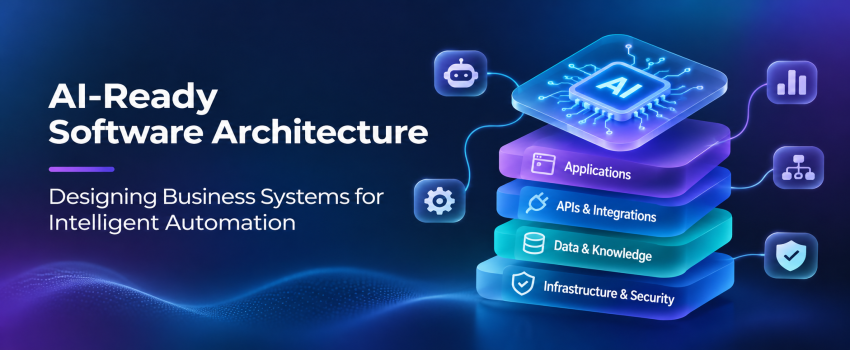
For many businesses, adopting AI starts with a relatively simple question: Where can we use AI? Maybe it is a customer-support chatbot. Maybe it is document processing, sales automation, predictive analytics, or an internal assistant that can search company information.
The first implementation can be surprisingly easy. The challenge begins when AI needs to become part of the software that a business actually depends on.
At that point, connecting an AI model to an application is no longer enough. The system needs access to reliable data, business applications, APIs, workflows, security controls, monitoring, and sometimes human approval.
This is where AI-ready software architecture becomes important.
An AI-ready architecture is not about adding AI to every part of an application. It is about designing software so that AI can be introduced where it creates genuine value while the rest of the system remains secure, reliable, scalable, and manageable.
What Does AI-Ready Software Architecture Mean?
AI-ready software architecture refers to a software foundation that can integrate AI capabilities into business applications without treating AI as an isolated add-on. A modern business application may combine several technologies:
- Business applications and user interfaces
- Databases and enterprise data
- APIs and third-party integrations
- AI and machine learning models
- Automation and workflow engines
- Authentication and authorization
- Monitoring and analytics
- Human approval workflows
The important part is how these components work together.
For example, imagine an AI assistant inside a CRM.
A basic implementation might allow a salesperson to ask:
“What happened with this customer recently?”
A more capable system could retrieve the customer's history, summarize previous conversations, identify an unresolved issue, recommend a next action, create a follow-up task, and wait for approval before updating the CRM.
The second scenario is much more than an AI chatbot.
It is an AI-enabled business workflow.
That distinction is becoming increasingly important as organizations move from experimenting with AI to integrating it into day-to-day operations.
AI Should Work With Business Systems, Not Sit Beside Them
One of the limitations of early AI implementations is that they often exist separately from the systems employees already use.
Employees may have an AI assistant in one window, a CRM in another, an ERP somewhere else, and internal documents stored across several platforms.
The result is another tool to manage rather than a genuine improvement to the workflow.
AI becomes much more valuable when it can work with existing systems.
For example, an AI-powered sales workflow could help a team analyze customer interactions, retrieve relevant product information, prepare quotations, update CRM records, and create follow-up tasks.
But that requires more than a model. The software architecture needs a reliable way for AI to interact with business applications. This is where APIs and integration layers become critical.
Rather than giving an AI system unrestricted access to a database, developers can expose controlled business functions through APIs. The application can then validate requests, enforce permissions, record actions, and decide what the AI is actually allowed to do. The AI provides intelligence. The application provides control. That separation is essential for enterprise systems.
Data Is the Foundation of Useful AI
Businesses often have plenty of data but still struggle to use it effectively with AI. The problem is rarely the volume of data. It is usually the structure, accessibility, quality, and governance of that data.
Customer information may exist in a CRM. Financial information may be stored in an ERP. Product documents may sit in cloud storage. Operational data may be spread across databases and third-party platforms.
An AI system needs access to the right information at the right time. This is why data architecture should be considered early when planning an AI implementation. For knowledge-based applications, retrieval-augmented generation (RAG) can allow an AI system to retrieve relevant business information before generating a response.
For example, rather than relying on a model's general knowledge, an internal employee assistant could retrieve information from approved company documents and use that information to answer a question.
But retrieval does not solve everything. Documents still need to be organized. Information needs to remain current. Access permissions need to be respected. Sensitive data needs appropriate protection.
A well-designed AI system therefore needs to consider not only how to generate an answer, but also where the information behind that answer comes from.
Custom Software Makes AI Integration More Flexible
Off-the-shelf applications can be useful, but businesses often have workflows that do not fit neatly into a standard product.
This becomes particularly noticeable when AI needs to interact with multiple business systems. A custom software solution can be designed around the organization's actual workflow instead of forcing the workflow to adapt to the software.
For example, a company might need a platform that combines:
- Customer and lead management
- AI-powered document processing
- Internal knowledge search
- Automated notifications
- Approval workflows
- Third-party API integrations
- Business analytics
- Role-based dashboards
These capabilities may exist across different products, but connecting them into one coherent workflow can become complicated.
A custom software development company in Bangalore's approach allows the architecture to be designed around those requirements from the beginning. This does not mean every business needs custom software.
It means customization becomes valuable when AI, automation, integrations, and business-specific processes need to work together in ways that generic software cannot easily support.
AI Agents Are Changing the Architecture Conversation
AI applications are also moving beyond simple question-and-answer interfaces.
AI agents can potentially interpret an objective, break it into tasks, use tools, retrieve information, and take actions.
Consider an internal procurement process.
Instead of simply asking an AI assistant to summarize supplier information, an agent could potentially:
- Retrieve supplier records.
- Compare pricing and availability.
- Check internal purchasing rules.
- Prepare a recommendation.
- Create a purchase request.
- Send it for human approval.
The important word here is potentially.
An agent should not automatically receive unrestricted access to every system simply because it can technically interact with them.
The architecture needs clear boundaries.
- Which tools can the agent access?
- Which information can it retrieve?
- Which actions require approval?
- What happens when the agent encounters something unexpected?
- How are actions recorded?
These questions become particularly important when AI moves from generating information to performing actions.
Human Oversight Still Matters
There is sometimes an assumption that successful AI adoption means removing humans from the process.
That is not necessarily the right goal.
For many enterprise workflows, the better approach is to allow AI to handle repetitive work while keeping people involved in decisions that have greater consequences.
An AI system might prepare a customer response, but a human approves it. It might identify a potentially fraudulent transaction, but an analyst makes the final decision.
It might prepare a quotation, but the sales manager approves it before it reaches the customer. This type of human-in-the-loop architecture provides a useful balance between automation and control.
As AI becomes more capable, knowing where not to automate can become just as important as knowing where automation makes sense.
Security Needs to Be Designed Around AI
AI introduces another layer to an organization's security model.
An AI assistant may have access to internal documents. An AI agent may be able to call APIs. A customer-facing application may process personal information through an AI service.
Each of these scenarios introduces questions about data access and permissions.
An AI system should not automatically inherit unrestricted access to everything available to the application.
Instead, access should be deliberately controlled. Depending on the use case, this can include:
- Role-based access
- API-level permissions
- Data-level access controls
- Authentication and authorization
- Audit logging
- Approval mechanisms
- Secure handling of sensitive information
- Restrictions on AI tool usage
Security should therefore be considered during architecture and development rather than added after the AI feature has already been deployed.
AI Systems Need Different Types of Testing
Traditional software testing remains essential, but AI-enabled applications introduce additional challenges.
A conventional software function is generally expected to produce predictable results.
AI systems can behave differently.
A model may generate different responses to similar inputs. A model update can change output quality. Changes to a retrieval system can affect the context supplied to the model.
This means an AI-enabled application should be tested at several levels. The software itself needs functional and integration testing.
The AI component needs evaluation for relevance, accuracy, consistency, and safety. And the complete workflow needs to be tested to make sure the AI behaves appropriately when interacting with real business systems.
For production applications, monitoring also becomes important. It is not enough to know that an API returned a successful response.
Businesses may need to understand whether the AI produced a useful result, whether users frequently overrode its recommendations, whether automated workflows failed, and how much individual AI operations cost.
In other words, AI observability needs to look at behaviour as well as system health.
Don't Build Around a Single AI Model
AI technology is evolving rapidly. The model that is the best fit for a particular business requirement today may not remain the best option indefinitely.
This is one reason businesses should think carefully about how tightly their applications are coupled to a particular AI provider.
A flexible architecture can create a layer between the business application and the underlying models.
This can make it easier to change models, introduce fallback options, manage usage, monitor performance, and adapt to new capabilities.
The goal is not to build an unnecessarily complicated multi-model platform.
The goal is simply to avoid making the entire software system dependent on one technology decision.
Good architecture leaves room for change.
That principle is particularly important in AI because the pace of change is unusually high.
What About Existing Legacy Software?
Many businesses cannot simply start over.
They may have ERP systems, CRM platforms, databases, and custom applications that have been running for years. Some of these systems may be difficult to replace because they contain important business processes and historical data.
This is where software modernization development can become part of an AI strategy.
Instead of replacing everything, organizations can gradually introduce modern APIs, integration layers, cloud services, and new applications around existing systems.
For example, a legacy application can remain the system of record while a modern service exposes selected capabilities through secure APIs.
An AI application can then interact with those services without requiring the entire legacy platform to be rebuilt immediately.
This incremental approach can make AI adoption more practical while reducing the risk of a large-scale system replacement.
How Businesses Can Start Building AI-Ready Software
There is no single architecture that every organization should copy.
The right approach depends on the business process, data, existing technology, security requirements, and level of automation required. A useful starting point is to look at the workflow rather than the AI technology.
- Where are employees spending time collecting information?
- Which processes involve repetitive decisions?
- Where do people repeatedly move information between systems?
- Which business knowledge is difficult for employees to find?
- Where are delays caused by manual processing?
These questions often reveal better AI opportunities than simply asking where a chatbot could be added. Once a suitable use case has been identified, the architecture can be designed around it.
For some businesses, that might mean an AI-powered knowledge assistant. For others, it could be intelligent document processing, predictive analytics, an AI-enabled CRM, workflow automation, or an agent that works across several enterprise systems. The technology should follow the business requirement.
The Goal Is Not to Make Everything Intelligent
AI is becoming an important part of modern software, but that does not mean every component of an application needs AI.
Some tasks are better handled by conventional business logic. Some benefit from AI assistance. Others may eventually be suitable for higher levels of automation.
The role of architecture is to make these components work together safely. A well-designed AI-enabled system should be able to evolve as AI capabilities improve without forcing the organization to rebuild its entire technology stack every time a new model or approach becomes available.
That is the real value of AI-ready architecture.
It gives businesses a foundation from which they can introduce intelligence where it is useful, automate repetitive work, integrate existing systems, and gradually move toward more sophisticated workflows.
Building the Next Generation of Business Software
The future of enterprise software is unlikely to be defined by AI alone.
Instead, AI will become another important layer within larger digital systems that combine applications, data, APIs, automation, analytics, and human decision-making.
The businesses that benefit most will not necessarily be those that adopt the most AI features. They will be the ones that understand where AI belongs in their software architecture and how to integrate it without losing control of the systems around it.
For organizations planning their next generation of business software, that means thinking beyond the model.
- Think about the data.
- Think about the integrations.
- Think about security.
- Think about human oversight.
- Think about how the system will be tested, monitored, and changed over time.
- And most importantly, start with the business problem rather than the technology.
When those foundations are designed properly, AI stops being an isolated experiment and becomes a practical part of the software that runs the business.

Nexevo Technologies is a Professional web designing and web development company bangalore, which is offers a full facility for designing a website at a reasonable price. We are award-winning web design and digital marketing company working since 2012.
Share with





 Call
 Whatsapp
