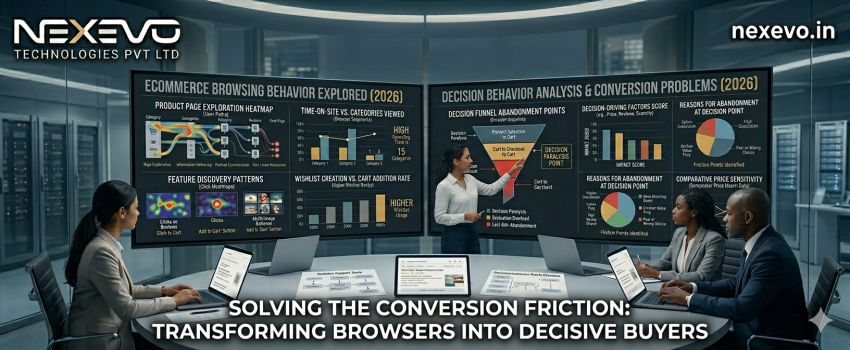
Your Ecommerce Website Is Built for Browsing—But Users Want Decisions (The 2026 Shift)



Many ecommerce websites struggle with conversions despite getting good traffic. This blog explains the shift from browsing behavior to decision-driven shopping and reveals why most stores fail to convert users in 2026—and what needs to change.
Introduction: The Problem No One Explains Clearly
You’re getting traffic.
Your ads are running.
Your SEO is bringing visitors.
Your analytics looks active.
But sales?
Still inconsistent.
Still lower than expected.
And the most frustrating part?
Nothing looks “wrong.”
Your website looks good.
Your products are decent.
Your pricing is competitive.
Yet users come… and leave.
This is where most ecommerce businesses get stuck.
They assume:
“We need more traffic”
But that’s rarely the real issue anymore.
The real issue is this:
Your website is built for browsing.
But your users are trying to decide.
And that mismatch is costing you sales every single day.
This shift is often described as ecommerce browsing vs decision behavior, where users no longer explore but make fast purchase decisions.
If you’re already seeing traffic but no results, you should also read:
Why Your Ecommerce Website Gets Traffic But No Sales
How Ecommerce Was Designed Earlier (The Browsing Model)
To understand the problem, you need to understand how ecommerce was originally built.
Earlier, online shopping behavior was slow.
Users would:
- explore multiple products
- open multiple tabs
- compare features
- take time before buying
Websites were designed to support this behavior.
That’s why most ecommerce stores still focus on:
- product categories
- filters
- endless scrolling
- multiple choices
The assumption was simple:
“Give users more options, they’ll eventually buy.”
And that worked.
But not anymore.
What Changed in 2026 — Users Don’t Browse, They Decide
User behavior hasn’t just “changed”—it has compressed.
Earlier, a user might spend 10–15 minutes browsing an ecommerce store.
Today, most decisions happen in under 5–10 seconds.
Think about your own behavior.
When you open a product page, you’re not reading everything.
You’re scanning:
- headline
- price
- product image
- reviews
- trust signals
Within seconds, your brain makes a decision:
“Continue or leave”
This is what most ecommerce businesses fail to understand.
They design websites assuming users will:
- explore categories
- compare products
- read detailed descriptions
But users today don’t behave like that.
They are not in exploration mode.
They are in decision mode.
Real scenario:
A user clicks on your product from Instagram or Google.
They land on your page.
Within 3–5 seconds:
- they don’t understand the product clearly
- they don’t see why it’s better
- they don’t feel trust
They leave.
Not because your product is bad.
But because your website didn’t help them decide fast enough.
This is exactly why users leave ecommerce websites quickly.
That’s the shift.
Why Most Ecommerce Websites Are Failing Today
Here’s the core problem:
Ecommerce websites are still built for browsing
Users are now in decision mode
That’s a direct mismatch.
Your website is saying:
“Take your time, explore”
Your users are saying:
“Help me decide fast”
And when that doesn’t happen, they leave.
This is why many stores see:
- good traffic
- low conversions
- high bounce rates
It’s not a traffic issue.
It’s a decision failure.
This is exactly why ecommerce websites fail to convert visitors even when traffic is high.
Problem 1: Too Many Choices, No Direction
More products do not mean more sales.
In fact, in many cases, they reduce conversions.
We’ve seen ecommerce stores with:
- 100+ products
- multiple categories
- filters everywhere
But users don’t use filters like you expect.
They don’t want to “figure things out.”
They want guidance.
Real example:
A fashion ecommerce store had:
- dozens of product variations
- multiple collections
- heavy navigation
Users were landing on category pages…
Scrolling…
Then leaving.
No interaction.
No add-to-cart.
What was wrong?
The store assumed users would explore.
But users didn’t want to explore.
They wanted:
“Show me what’s best”
“Tell me what to choose”
What changed:
- highlighted top products
- reduced visible choices
- added “best pick” sections
Result:
- higher engagement
- improved add-to-cart
- better conversions
The lesson:
Users don’t want more options.
They want clear decisions.
Problem 2: Product Pages Don’t Answer Fast Enough
Most product pages are written like brochures.
They describe.
They explain.
They list features.
But they don’t sell decisions quickly.
Real scenario:
User lands on a product page.
They scroll.
They read a bit.
But they still don’t understand:
- why this product matters
- how it helps them
- why they should trust it
So they hesitate.
And hesitation kills conversions.
What we observed in projects:
- bury key information
- don’t highlight value clearly
- lack strong messaging
Users shouldn’t have to “search for clarity.”
Clarity should be immediate.
What works instead:
- show benefit first
- highlight trust instantly
- reduce reading effort
Because users don’t want to read.
They want to decide.
This is one of the main reasons why ecommerce visitors leave without buying.
If your product pages are not converting, this will give deeper insight:
Why Customers Add to Cart but Never Complete Purchase
Problem 3: Trust Is Not Instant
Trust used to be built over time.
Now it’s judged instantly.
Within seconds, users decide:
“Is this website safe?”
“Is this brand reliable?”
Real example:
Two ecommerce stores selling similar products.
Store A:
- clean design
- visible reviews
- strong messaging
Store B:
- cluttered layout
- weak content
- no social proof
Both had similar traffic.
But Store A converted significantly better.
Why?
Because trust was immediate.
Users didn’t need to think.
They felt confident instantly.
In ecommerce, trust is not a bonus.
It’s a requirement.
Problem 4: Checkout Feels Like Work
Most ecommerce businesses think:
“If users reach checkout, they will buy.”
That’s not true.
Checkout is where many decisions break.
Real scenario:
User adds product to cart.
They’re interested.
They’re ready.
Then:
- multiple steps
- form fields
- login requirements
- unclear pricing
They stop.
What we’ve seen:
- forced signup
- slow loading
- hidden charges
can kill conversions instantly.
Example:
A store reduced:
- checkout steps
- unnecessary fields
Result:
- higher completion rate
- reduced drop-offs
At checkout, users don’t want process.
They want completion.
Real Example (What We See in Projects)
We worked with an ecommerce business that had:
- good traffic from ads
- decent SEO visibility
- strong product quality
But conversions were low.
Initially, the assumption was:
“We need more traffic”
But when we analyzed behavior:
- users dropping from product pages
- low engagement
- checkout abandonment
Core issues:
- too many product options
- unclear messaging
- lack of trust signals
- friction in checkout
What we changed:
- simplified product presentation
- improved clarity
- added trust indicators
- streamlined checkout
Result:
- improved conversion rate
- increased sales
- better user flow
Without increasing traffic.
That’s the reality most businesses miss.
What High-Converting Ecommerce Stores Do Differently
High-performing stores understand this shift.
They don’t try to:
1. show everything
2. explain everything
They focus on:
guiding decisions
- simplify choices
- highlight best options
- build trust instantly
- reduce friction
They don’t let users think too much.
They help users decide faster.
Today, ecommerce users make decisions faster, and this instant buying behavior is shaping how digital commerce works.
That’s the difference.
How to Fix This (Practical Approach)
If your ecommerce store is not converting, don’t start with traffic.
Start with this:
1. Reduce choices
Guide users instead of overwhelming them.
2. Improve clarity
Make your value obvious within seconds.
3. Build trust instantly
Show proof, credibility, and reassurance.
4. Simplify checkout
Remove unnecessary friction.
5. Think like a user
Not like a business owner.
Because users don’t care about your structure.
They care about their decision.
When You Should Consider Ecommerce Development
If your website is:
- getting traffic but not converting
- confusing users
- losing customers at checkout
Then your issue is not marketing.
It’s your website experience.
If you’re evaluating whether your store needs a structural change, read:
How Do You Know Your Ecommerce Website Needs a Redesign?
Also, if you're planning for future ecommerce trends, this is critical:
Why Your Ecommerce Store Isn’t Ready for AI Shopping Agents
Explore how we approach ecommerce differently:
https://www.nexevo.in/ecommerce-web-development
Final Thoughts: The Real Shift
The biggest mistake ecommerce businesses make today is assuming:
“If we get more traffic, we’ll get more sales”
That’s no longer true.
Because users have changed.
And your website hasn’t.
The new reality is simple:
1. Users don’t browse
2. Users decide
And if your website doesn’t support that…
You lose them.
Final CTA
If your ecommerce store is getting traffic but not converting, you’re not alone.
But you are losing opportunities.
Every visitor who leaves without buying is lost revenue.
And in most cases, it’s preventable.
If you want to fix what’s actually stopping your sales, now is the right time to act.
Explore our ecommerce development services:
https://www.nexevo.in/ecommerce-web-development
FAQ: Why Ecommerce Websites Are Not Converting in 2026
What is ecommerce browsing vs decision behavior?
Ecommerce browsing vs decision behavior refers to the shift where users no longer explore products but make quick purchase decisions based on clarity, trust, and ease of use.
Why do users leave ecommerce websites so quickly?
Users leave ecommerce websites quickly when they don’t find immediate clarity, trust signals, or a smooth experience that helps them make decisions fast.
Why do ecommerce websites fail to convert visitors?
Most ecommerce websites fail to convert visitors because they are built for browsing instead of supporting fast decision-making behavior.
Why do ecommerce visitors leave without buying?
Visitors leave without buying when product value is unclear, trust is missing, or the buying process feels complicated.
How does mobile ecommerce behavior affect conversions?
This is especially visible in mobile ecommerce behavior, where users expect faster interactions and immediate clarity.
What is instant buying behavior in ecommerce?
Instant buying behavior refers to users making quick decisions without deep browsing, based on trust, clarity, and ease of purchase.

Jeyaprabhakaran Peter is the Senior Digital Marketing Specialist at Nexevo Technologies. With expertise in Digital Marketing, SEO, PPC, SMM, Content Strategy, Website Design, Figma Designing, and SEO Strategy, he helps brands grow their online presence effectively. As a skilled SEO Expert and Website Designer, he blends creativity with analytics to craft impactful digital strategies that deliver measurable results across various industries.
Share with






 Call
Call Whatsapp