What Should a Modern Business Website Be Able to Do in 2027?



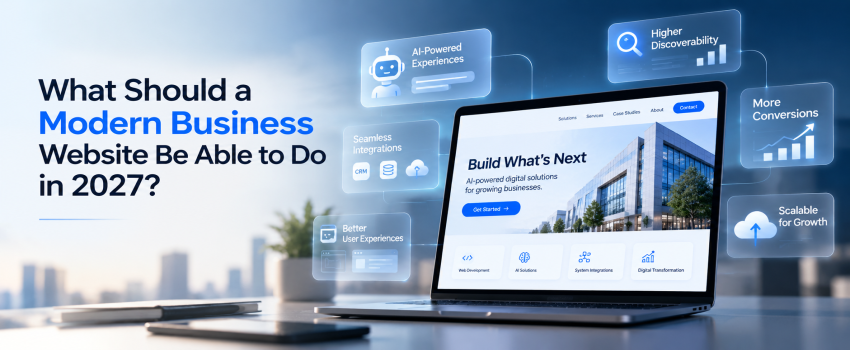
A business website in 2027 should do much more than present information about a company. Customers expect digital experiences to be fast, useful, personalized, and easy to interact with. Businesses, meanwhile, need their websites to work alongside marketing, sales, customer service, and internal systems.
The question is no longer simply, “Does your business have a website?” It is:
“What can your website actually do for your business?”
Here are some of the capabilities that are becoming increasingly important for modern business websites.
1. Understand What Visitors Need
A modern website should make it easy for visitors to find the information that matters to them. This goes beyond attractive design. Navigation, page structure, content, search functionality, and calls to action should work together to create a clear user journey.
For example: A software company can guide a visitor from a specific business problem to the right solution, relevant case study, and enquiry option instead of making them search through multiple pages.
This is where thoughtful UI/UX design becomes important. The goal is not simply to make a website look good, but to make it easier for people to understand and take action.
2. Connect With the Systems Behind Your Business
A website doesn't have to operate as a standalone platform. Modern websites can connect with CRM systems, ERP platforms, payment gateways, marketing tools, customer portals, and other business applications through APIs and integrations.
For example: When someone submits an enquiry, the website can automatically send the lead to the company's CRM, notify the sales team, and trigger a follow-up workflow.
Instead of manually moving information between systems, the website becomes part of the business process.
For businesses that need more than a standard website, affordable web development company can provide the flexibility to build these integrations around specific requirements.
3. Use AI Where It Solves a Real Problem
AI can make a website more useful, but adding an AI feature simply because it is popular doesn't necessarily create value. The better approach is to identify where customers or employees are spending time and determine whether AI can make that process faster or more useful.
For example: A website with hundreds of products or services could use AI-powered search to help visitors find relevant options using natural language instead of navigating through multiple categories.
Other possibilities include AI-powered chat, recommendations, lead qualification, content assistance, and intelligent automation.
The important question is not “Where can we add AI?”
It is “Where can AI improve the experience or solve a business problem?”
4. Turn Website Visits Into Business Opportunities
A website should support business growth, not simply generate traffic. Modern websites can create more meaningful conversion journeys through clear calls to action, enquiry forms, booking systems, calculators, product demonstrations, and personalized experiences.
For example: Instead of displaying a generic “Contact Us” button, a consulting company could allow visitors to select their business requirement and request a consultation based on that specific need.
This gives the business better-quality information while creating a more relevant experience for the visitor.
5. Be Discoverable in Search and AI Experiences
People are finding businesses not only through traditional search results but increasingly through AI-powered search and answer experiences. A modern website therefore needs a clear structure that helps search engines and AI systems understand the business, its expertise, services, and content. That includes strong technical foundations, meaningful internal linking, structured content, clear answers to common questions, and consistent information about the business.
For example, a company looking for a web development company in Bangalore should be able to understand from your website exactly what you do, who you work with, what technologies you use, and what type of projects you handle. SEO should therefore be considered during development rather than treated as something added after the website is launched.
6. Grow Alongside the Business
A website that works for a small business today may not be enough when the business grows. As requirements change, a website may need new features, integrations, customer accounts, dashboards, automation, or connections with internal systems.
For example: A business may start with a corporate website and later add an online customer portal, CRM integration, payment functionality, or an AI-powered support system. Building with scalability in mind makes it easier to introduce these capabilities without completely rebuilding the digital platform.
A Modern Website Is More Than a Website
The modern business website is becoming the front door to a company's wider digital ecosystem. It can connect customers with information, sales teams with leads, employees with business systems, and businesses with data and automation.
At Nexevo, we combine web development, software engineering, AI, automation, and digital transformation to build digital solutions around real business requirements.
Whether a business needs a high-performing website, a custom web application, system integrations, or an AI-powered digital experience, the focus should always remain the same: build technology that creates real business value.
Ready to Build a Smarter Digital Experience?
If you're planning a new website, redesign, custom web application, or digital transformation project, talk to Nexevo about your requirements.
Explore more about our web development service in Bangalore

Nexevo Technologies is a Professional web designing and web development company bangalore, which is offers a full facility for designing a website at a reasonable price. We are award-winning web design and digital marketing company working since 2012.
Share with





 Call
 Whatsapp
