Nvidia’s AI Dominance Explained: CUDA, H100 & the Future of AI Chips



Navigate to
- The Anatomy of Nvidia’s Dominance
- The CUDA Moat: Beyond Hardware
- The Rise of Hyperscaler In-House Silicon
- Startup Challenges and the Memory Bottleneck
- The Path to a Multi-Vendor Future
- Conclusion
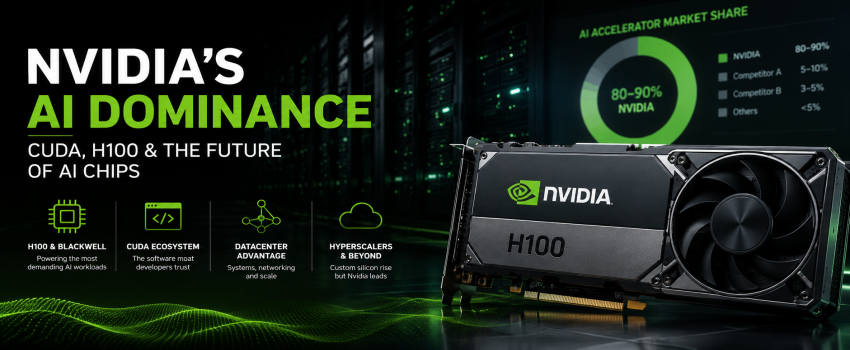
The meteoric rise of generative AI has fundamentally shifted the global technology landscape, placing Nvidia at the epicenter of a trillion-dollar gold rush. With its H100 and Blackwell architectures becoming the de facto gold standard for training Large Language Models (LLMs), the chipmaker currently commands an estimated 80% to 90% share of the AI accelerator market. As enterprise demand for high-compute infrastructure continues to outpace supply, Nvidia’s dominance has sparked critical questions regarding market sustainability, vendor lock-in, and the viability of emerging competitors. This article examines the structural advantages protecting Nvidia’s fortress and analyzes whether the current market hierarchy is destined for disruption or long-term solidification.
The Anatomy of Nvidia’s Dominance
Nvidia’s current market position is not merely the result of superior chip design; it is the culmination of a decade-long strategy that integrated hardware, software, and networking into a cohesive ecosystem. While competitors have historically focused on pure performance metrics—such as FLOPS (Floating Point Operations Per Second)—Nvidia invested heavily in the vertical integration of its data center offerings.
Hardware Verticalization
Nvidia transitioned from being a component supplier to a systems provider. By moving beyond selling individual GPUs to selling entire integrated systems like the DGX SuperPOD, they have simplified the deployment process for massive AI clusters. This "full-stack" approach allows Nvidia to control the interaction between memory, interconnects, and processing cores, optimizing performance in ways that modular, off-the-shelf competitors find difficult to replicate.
The Network Advantage
The acquisition of Mellanox was perhaps the most strategic move in the company’s history. High-performance AI computing relies as much on data transmission speeds as it does on processing power. By controlling InfiniBand and high-speed Ethernet networking, Nvidia ensures that its GPUs communicate with minimal latency, creating a performance floor that makes non-Nvidia clusters feel fragmented or inefficient by comparison.
The CUDA Moat: Beyond Hardware
If the H100 GPU is the engine of the AI revolution, CUDA (Compute Unified Device Architecture) is the operating system that runs it. Launched nearly two decades ago, CUDA has become the universal language for parallel computing. For developers, researchers, and data scientists, the barrier to switching away from Nvidia is not the hardware—it is the software stack.
Developer Ecosystem and Legacy
Millions of lines of code have been written using CUDA libraries. Academic research, open-source frameworks like PyTorch and TensorFlow, and production-grade enterprise software are all deeply intertwined with Nvidia’s proprietary architecture. Replacing this would require a monumental effort in porting software, which most enterprises are unwilling to undertake due to the risk of downtime and decreased performance.
The Difficulty of Abstraction
While companies like AMD are pushing the ROCm (Radeon Open Compute) platform to compete with CUDA, the "abstraction layer" problem remains. Developers prefer the reliability of a mature, battle-tested ecosystem. Nvidia’s commitment to backward compatibility and its massive community support mean that for any new AI project, the path of least resistance is almost always to stick with Nvidia, further reinforcing the company's market position.
The Rise of Hyperscalers In-House Silicon
The most significant threat to Nvidia’s supremacy comes not from direct hardware rivals like Intel or AMD, but from its own largest customers. Amazon (AWS), Google (Alphabet), and Microsoft (Azure) are currently engaged in a massive effort to develop custom AI silicon, seeking to reduce their dependency on Nvidia and lower the cost of their infrastructure.
The Motivation for Custom Silicon
• Cost Efficiency: Purchasing Nvidia GPUs at scale is a massive capital expenditure. Custom chips (like Google’s TPU or AWS’s Trainium) are designed specifically for the unique workloads of those providers.
• Supply Chain Control: By designing their own chips, hyperscalers mitigate the risk of supply shortages and the leverage Nvidia holds during price negotiations.
• Workload Optimization: General-purpose GPUs are powerful, but they are not always the most efficient for specific tasks like inference. Custom chips allow hyperscalers to optimize for power consumption and thermal performance, which is vital for massive data centers.
Despite these efforts, even the tech giants admit that they still require Nvidia hardware for the most complex, cutting-edge training tasks. The custom chips are excellent for inference, but they have yet to fully displace Nvidia in the "training" category, where peak performance and developer support are non-negotiable.
Startup Challenges and the Memory Bottleneck
The hardware startup landscape is currently flooded with venture capital, with firms like Groq, Cerebras, and SambaNova attempting to challenge the status quo. However, these companies face a harsh reality: the "Memory Wall."
The Bandwidth Hurdle
Modern AI models are limited not by how fast a chip can calculate, but by how fast it can access data from memory. Nvidia has mastered the use of High Bandwidth Memory (HBM), and their ability to secure supply chain priority for these components remains a massive barrier to entry for startups.
The Scaling Problem
Building a chip is easy; building a cluster is hard. Startups often produce high-performing individual chips, but they struggle to provide the software orchestration necessary to link thousands of these chips together. Without the massive networking infrastructure that Nvidia provides, startups find it difficult to prove their chips are viable for the "frontier" models that companies like OpenAI or Anthropic are building.
The Path to a Multi-Vendor Future
While Nvidia currently maintains a stranglehold on the market, the long-term future of AI infrastructure is likely to be heterogeneous. The industry is moving toward a "best-of-breed" approach where companies mix and match hardware based on the specific phase of the AI lifecycle.
Training vs. Inference
The training phase will likely remain dominated by Nvidia for the foreseeable future due to the sheer power and software ecosystem required. However, the inference market—the process of running models to generate answers—is much more open. Because inference is less compute-intensive than training, it is a prime target for AMD, custom silicon, and specialized inference accelerators.
Open Standards
Initiatives like the Unified Acceleration Foundation (UXL), backed by companies like Intel and ARM, aim to create an open-source alternative to CUDA. If these initiatives gain traction, they could eventually erode the "CUDA moat," allowing for greater hardware interoperability. However, this is a multi-year, if not decade-long, project that requires significant industry-wide cooperation.
Conclusion
Nvidia’s current dominance is protected by a sophisticated synergy of high-performance hardware, a deeply entrenched software ecosystem, and strategic networking capabilities. While the hyperscalers are aggressively pursuing in-house silicon and startups are innovating at the edge, none have yet managed to replicate the full-stack experience that makes Nvidia the default choice for the AI industry.
For professionals in the sector, the takeaway is clear: Nvidia will likely remain the primary architect of AI infrastructure for the next several years. However, the market is beginning to show signs of bifurcation. Training will remain a stronghold for Nvidia, while inference and edge computing will provide the necessary openings for competitors to capture market share. The "stranglehold" is real, but it is not unbreakable. As AI workloads evolve and the industry pushes for more cost-effective, specialized hardware, we are likely moving toward a more fragmented, diverse, and ultimately more competitive ecosystem.

Nexevo Technologies is a Professional web designing and web development company bangalore, which is offers a full facility for designing a website at a reasonable price. We are award-winning web design and digital marketing company working since 2012.
Share with





 Call
Call Whatsapp