How OCI Enterprise AI and Grok 4.3 Are Redefining Enterprise AI in 2026



Navigate to
- The Backstory That Set the Stage
- Why This Combination Hits Different
- Key Benefits of OCI Enterprise AI + Grok 4.3
- The Enterprise Use Cases That Get Exciting
- The Bigger Picture: Oracle’s AI Flywheel Is Spinning
- The Cost Equation That CIOs Will Love
- What This Means for Your AI Strategy
- The Bottom Line
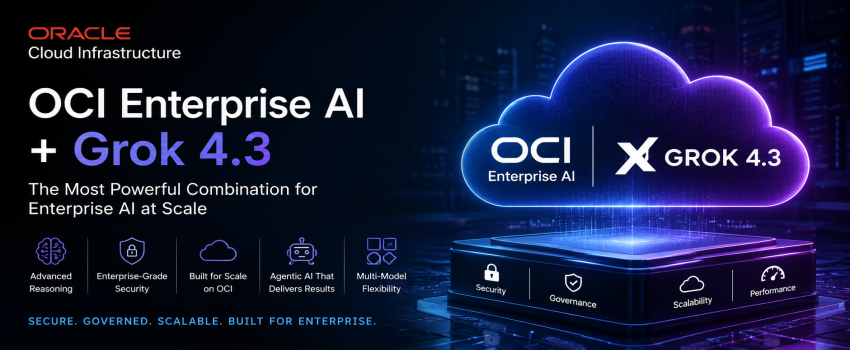
If you blinked last month, you might have missed one of the most significant developments in cloud-based artificial intelligence this year. Oracle Cloud Infrastructure just made Grok 4.3 available on OCI Enterprise AI, and the implications are massive for every organization serious about deploying production-grade AI at scale.
Let’s break down why this matters and why your competitors are probably already paying attention.
The Backstory That Set the Stage
Oracle went generally available with OCI Enterprise AI in March 2026, positioning it as an end-to-end developer platform for building, managing, and deploying AI workloads. The pitch was straightforward: stop struggling to stitch together fragmented AI tools and start shipping production AI faster.
Meanwhile, xAI quietly dropped Grok 4.3 in April 2026 with zero fanfare — no press release, no keynote presentation. The model just appeared in the selector, and the AI community lost its collective mind. A one-million-token context window. Native video understanding. Enhanced multi-step reasoning. Built-in always-on reasoning. And benchmark scores that put it at the top of enterprise domains like corporate finance and case law.
Within a single day of Grok 4.3’s public release, Oracle had it running on OCI Enterprise AI. One day. That speed tells you everything about Oracle’s strategy right now.
Why This Combination Hits Different
Here’s the thing about enterprise AI in 2026: having a powerful model is table stakes. What separates winners from everyone else is how that model integrates into real-world workflows with governance, security, and scale baked in from day one.
That’s exactly what the OCI Enterprise AI and Grok 4.3 combination delivers.
OCI Enterprise AI isn’t just a model hosting service. It brings together model intelligence, agentic tooling, and governance controls in a single unified offering. Pair that with a model that excels at complex reasoning, long-document analysis, and agentic task execution, and you get something genuinely compelling for enterprise teams.
Think about it: Grok 4.3 processes up to a million tokens of context. OCI Enterprise AI provides the infrastructure, the guardrails, and the deployment pipeline. Together, that means your team can feed entire contract libraries, regulatory documents, or financial datasets into an AI agent that actually reasons through them — running on infrastructure your security team can approve.
Key Benefits of OCI Enterprise AI + Grok 4.3
When you combine Oracle’s enterprise-grade cloud platform with one of the most powerful reasoning models on the market, the benefits stack up fast. Here’s what organizations stand to gain.
1. Unmatched Reasoning Power at Enterprise Scale
Grok 4.3 brings always-on reasoning and a one-million-token context window to OCI. That means your AI can process and reason through entire legal contracts, financial reports, or codebases in a single pass — no chunking workarounds, no lost context. For enterprises dealing with complex, data-heavy decisions, this is a game changer.
2. Enterprise-Grade Security and Governance Built In
OCI Enterprise AI wraps Grok 4.3 in layers of enterprise security that standalone API access simply cannot match. Zero data retention endpoints ensure your proprietary data never persists beyond the inference call. Sovereign AI options let you control exactly which region processes your data. Built-in access controls, guardrails, and dedicated AI clusters mean your CISO can sleep at night while your AI team ships fast.
3. Faster Time-to-Production
The biggest bottleneck in enterprise AI isn’t model quality — it’s the gap between a successful prototype and a production deployment. OCI Enterprise AI eliminates that gap by providing managed infrastructure, automated scaling, and a unified API surface. Teams can go from experimenting with Grok 4.3 in the console playground to running production workloads through the API without re-architecting anything.
4. Multi-Model Flexibility Without Vendor Lock-In
Grok 4.3 is powerful, but it doesn’t have to be your only model. OCI Enterprise AI gives you access to Grok, Meta Llama, Cohere, Mistral, NVIDIA Nemotron, and more through the same consistent API. Route different tasks to different models based on performance, cost, or capability. Switch providers as newer models drop. Your architecture stays stable while your AI keeps getting smarter.
5. Agentic AI That Actually Works in the Real World
Grok 4.3 has topped independent leaderboards for agentic tool calling and instruction following. Combine that with OCI’s Enterprise AI agents, composable workflow primitives, and the Responses API, and you get AI agents that don’t just answer questions — they take actions, query databases, execute code, and orchestrate multi-step workflows. This is where AI stops being a chatbot and starts being a workforce multiplier.
6. Dramatic Cost Efficiency
Grok 4.3 delivers roughly 20% lower benchmark costs compared to its predecessor while scoring higher on intelligence indices. On OCI, the on-demand pricing model means zero upfront infrastructure investment. No reserved GPU instances, no idle compute costs, no capacity planning headaches. You pay for what you use, and what you use just got significantly cheaper per unit of intelligence.
7. Multimodal Capabilities Out of the Box
Grok 4.3 natively processes both text and images, with video understanding capabilities expanding the scope of what enterprise AI can handle. Analyze product images alongside inventory data. Process scanned documents with visual elements. Review charts, diagrams, and screenshots alongside written reports. When paired with NVIDIA Nemotron on OCI for audio and video, the multimodal possibilities become truly comprehensive.
8. Seamless Integration with Existing Oracle Ecosystems
For the millions of organizations already running Oracle databases, ERP systems, or cloud infrastructure, this isn’t a net-new platform to adopt — it’s a capability upgrade on infrastructure they already trust. With managed MCP servers enabling AI agents to securely query Oracle databases, and native integration with Oracle Analytics and Autonomous AI Database, the value compounds across your entire Oracle stack.
9. Future-Proof Architecture
The AI model landscape changes every few weeks. Oracle’s one-day integration of Grok 4.3 after its public release proves this platform moves at the speed of the market. When the next breakthrough model drops, OCI will likely have it available before your team finishes reading the announcement blog post. Your investment in OCI Enterprise AI isn’t just buying today’s capabilities — it’s buying a platform that continuously absorbs tomorrow’s.
10. Regulatory Readiness and Compliance Confidence
With AI regulation accelerating worldwide, deploying powerful models on platforms without governance is a ticking liability. OCI Enterprise AI is FedRAMP authorized for government workloads, offers sovereign AI deployment options, and provides consistent audit trails and access controls. Whether you’re in healthcare, financial services, or the public sector, this combination gives you the power of frontier AI with the compliance posture your regulators demand.
The Enterprise Use Cases That Get Exciting
This isn’t theoretical. Here are the scenarios where this pairing starts to shine.
Financial analysis and compliance teams can now run complex multi-step investigations across massive document sets. Grok 4.3 has been ranked at the top for enterprise domains like corporate finance and case law, and OCI’s zero data retention endpoints mean sensitive information doesn’t linger where it shouldn’t.
Software development organizations get access to a model with strong coding and automation capabilities, deployed through OCI’s managed infrastructure. No more spinning up bespoke GPU clusters or wrestling with model serving at 2 AM.
Operations and analytics teams benefit from the agentic capabilities on both sides. OCI Enterprise AI supports building agentic workflows with open standards, and Grok 4.3 brings native tool-calling abilities that have topped independent leaderboards for agentic task performance.
Multimodal workflows become real. Grok 4.3 handles text and image inputs natively, and the broader OCI ecosystem now includes models like NVIDIA Nemotron for video, audio, and cross-modal reasoning. The days of stitching together five different APIs for a single workflow are numbered.
The Bigger Picture: Oracle’s AI Flywheel Is Spinning
Here’s what makes this particularly interesting from a strategic angle. Oracle isn’t just collecting models like trading cards. There’s a deliberate architecture being built here.
OCI Enterprise AI provides model choice without lock-in, meaning teams can route different tasks to different models through a consistent API surface. Sovereign AI options let organizations control exactly where their data lives and gets processed. Enterprise AI agents, which went generally available in March 2026, add composable building blocks for production-grade agentic applications. And the Responses API brings OpenAI SDK compatibility, which means existing codebases can migrate without a rewrite.
Add the managed MCP servers for Oracle databases that launched in May 2026, and you start to see an ecosystem where AI agents can securely query enterprise data, reason through complex problems, and take action — all within a governed environment.
Grok 4.3 slots into this ecosystem as a reasoning powerhouse. It’s not the only model available on OCI (Meta Llama, Cohere, Mistral, and others are all there), but for workloads that demand deep logical inference and long-context analysis, it represents a serious option.
The Cost Equation That CIOs Will Love
Let’s talk money, because that’s ultimately where enterprise decisions live.
Grok 4.3 comes in at competitive per-token pricing on the xAI API, and independent analysis has shown it delivers strong cost-efficiency on intelligence benchmarks. On OCI, the on-demand model means you pay per inference call with no upfront commitment. That’s a meaningful shift from the traditional approach of provisioning expensive dedicated GPU clusters before you’ve even validated your use case.
For organizations already invested in Oracle’s ecosystem — whether for databases, ERP, or cloud infrastructure — this is essentially adding frontier AI capability to a platform they’re already running. The incremental cost of experimentation just dropped dramatically.
What This Means for Your AI Strategy
If you’re leading an enterprise AI initiative right now, this development should be on your radar for three reasons.
First, the model diversity on OCI has reached a tipping point. Having access to Grok, Llama, Cohere, Mistral, and more through a single governed platform means you can match models to use cases instead of forcing every problem through the same solution.
Second, the speed at which Oracle is integrating new models signals a platform that’s keeping pace with the fastest-moving space in technology. One-day integration turnaround isn’t just impressive — it’s operationally critical when model capabilities are leapfrogging each other monthly.
Third, the governance story matters more than ever. With regulatory frameworks tightening globally and enterprise boards asking harder questions about AI risk, having sovereign AI options, zero data retention endpoints, and built-in access controls isn’t a nice-to-have. It’s becoming a requirement.
The Bottom Line
The combination of OCI Enterprise AI and Grok 4.3 represents something the enterprise AI market has been waiting for: frontier-level reasoning capability, delivered through a managed platform, with the governance and security controls that real organizations actually need.
This isn’t about hype. This is about the infrastructure layer of enterprise AI maturing to a point where deploying advanced models stops being a science project and starts being a business operation.
The organizations that move on this now won’t just have better AI. They’ll have faster AI, more secure AI, and a platform that scales with them as the next generation of models arrives.
And in this market, that next generation is probably about three weeks away.

Nexevo Technologies is a Professional web designing and web development company bangalore, which is offers a full facility for designing a website at a reasonable price. We are award-winning web design and digital marketing company working since 2012.
Share with




 Call
Call Whatsapp