Shadow AI Risks: 7 Hidden Threats Every Business Must Stop



Navigate to
- What Are Shadow AI Risks?
- How Unauthorized AI Tools Enter the Workplace
- Top 7 Shadow AI Risks Threatening Your Business
- The Psychology Behind Shadow AI Usage
- Real-World Examples of Shadow AI Failures
- How to Manage Shadow AI Effectively
- Building a Secure AI Policy < li>The Role of the CISO in Combating AI Threats
- Conclusion: Stop Shadow AI Risks Today
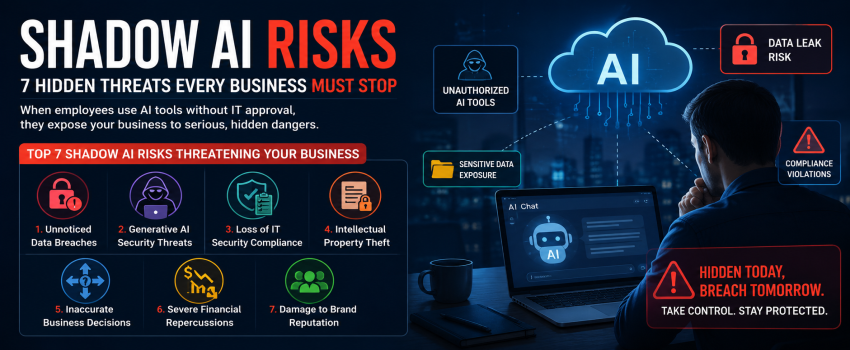
Shadow AI risks are growing faster than most IT departments can track. Employees are constantly seeking new ways to boost productivity and finish daily tasks. They often turn to artificial intelligence to get the job done quickly.
However, this incredible convenience comes at a massive cost. When workers bypass official IT channels, they expose the company to serious dangers. Your security team might not even know these digital threats exist.
Understanding how to handle these challenges is vital for modern businesses. You must take action before a major corporate data breach occurs. Let us explore why this growing tech trend is so dangerous.
What Are Shadow AI Risks?
Shadow AI risks refer to the dangers of employees using artificial intelligence without IT approval. This happens when staff members sign up for consumer-grade AI web applications. They do this without vetting the software through proper security channels.
These consumer applications often lack enterprise-level security protocols. As a result, sensitive corporate data is fed directly into public machine learning models. This creates a massive blind spot for your IT and compliance teams.
When IT leaders cannot see the software being used, they cannot secure it. This lack of visibility is the absolute core issue. It leaves your entire organization completely vulnerable to advanced cyberattacks.
How Unauthorized AI Tools Enter the Workplace
Employees rarely use unauthorized AI tools with malicious intent to harm the company. They simply want to write emails faster or analyze complex data more efficiently. The barrier to entry for these applications is incredibly low.
Anyone with a web browser and an email address can create a free account. In minutes, an employee can start pasting sensitive company code into a public chatbot. This bypassing of official IT procurement is happening daily across the globe.
Marketing teams use unvetted AI to generate campaign copy and social media posts. Financial analysts use free tools to summarize quarterly earnings reports. Every single department is a potential entry point for these unauthorized AI tools.
Top 7 Shadow AI Risks Threatening Your Business
Ignoring the problem will not make it magically go away. You must understand the specific shadow AI risks targeting your corporate network. Here are the seven biggest threats you face today.
1. Unnoticed Data Breaches
The most immediate and terrifying threat is a severe data breach. When employees input customer information into free AI platforms, that data leaves your control. The AI provider may store, read, or use that data to train future models.
If the AI company suffers a cyberattack, your corporate data is exposed to hackers. You will not even know it happened because the tool was never approved. This makes incident response and damage control nearly impossible.
2. Generative AI Security Threats
We are seeing a massive and sudden rise in generative AI security threats. Hackers are actively targeting popular AI platforms to steal valuable user inputs. They know employees are feeding these systems highly valuable corporate secrets.
Furthermore, some malicious AI apps are designed specifically to harvest sensitive data. They masquerade as helpful productivity boosters to trick unsuspecting workers. Once installed, they silently siphon information back to cybercriminals.
Protecting against generative AI security threats requires constant vigilance and education. You need robust endpoint detection systems to catch these rogue applications.
3. Loss of IT Security Compliance
Maintaining IT security compliance is a top priority for any modern business. Frameworks like GDPR, HIPAA, and SOC 2 require strict data governance and auditing. Unregulated AI usage shatters this governance completely.
If an employee uploads protected health information to a public AI, you have violated HIPAA. The regulatory fines for these severe violations can be financially devastating. You may also face intense legal scrutiny from government agencies.
Restoring IT security compliance after an AI-related breach is incredibly expensive. It also destroys hard-earned trust with your clients and business partners.
4. Intellectual Property Theft
Your company's intellectual property is arguably its most valuable asset. Software developers often use AI to debug proprietary source code faster. This puts your core digital product at massive risk of exposure.
Once your code is in a public AI model, it could be regurgitated to a direct competitor. The AI does not know it is sharing confidential information. It simply uses the data it was trained on to answer user prompts.
This form of accidental IP theft is one of the most insidious dangers. It happens quietly in the background and is very difficult to prove in court.
5. Inaccurate Business Decisions
Artificial intelligence models are notorious for hallucinating or providing false information. When employees rely on unvetted tools, they act on bad data. This ultimately leads to incredibly poor strategic decisions.
A flawed financial projection generated by a free AI tool can cost millions of dollars. If the tool is hidden, managers cannot verify the source of the data. They blindly trust the output because it looks professional.
Quality control becomes impossible without strict IT oversight. You must ensure all automated tools meet strict accuracy and reliability standards.
6. Severe Financial Repercussions
The financial impact of unregulated AI goes far beyond simple compliance fines. You may face massive class-action lawsuits from clients whose data was leaked. Your corporate cyber insurance premiums will also skyrocket after an incident.
Additionally, employees often expense premium versions of these unapproved tools on corporate cards. This leads to wasted IT budgets and duplicate software subscriptions across departments. Centralizing your software purchases prevents this hidden financial drain.
Consolidating your tech stack saves money and drastically improves your security posture. It is a win-win scenario for the entire organization.
7. Hidden AI Usage Blind Spots
Network administrators simply cannot protect what they cannot see. Hidden AI usage creates massive blind spots in your overall security architecture. Traditional corporate firewalls often fail to block these dynamic web-based applications.
Employees might use personal smartphones to access AI tools for work purposes. This completely circumvents your corporate network security and monitoring tools. The hidden AI usage continues to grow unchecked every single day.
Gaining visibility into these dangerous blind spots is absolutely critical. You need specialized monitoring software to detect this stealthy network activity.
The Psychology Behind Shadow AI Usage
Understanding exactly why employees bypass security is crucial to solving the problem. Staff members are under immense daily pressure to deliver results quickly. They often view corporate security protocols as annoying roadblocks to their success.
When a stressful deadline is looming, convenience almost always beats compliance. An employee will choose a free, unvetted AI tool if it saves them three hours of typing. They rarely stop to consider the long-term shadow AI risks.
This behavioral pattern is incredibly difficult to break. You cannot solve it with blocking technology alone. You must actively address the underlying workplace culture.
Real-World Examples of Shadow AI Failures
Theory is one thing, but real-world disasters prove the true danger. Several major corporations have already suffered massive leaks due to unregulated artificial intelligence. These high-profile incidents serve as a stark warning to the entire IT sector.
In one famous case, engineers pasted proprietary source code into a public chatbot to find a bug. The chatbot provider logged that confidential code into their vast training data. Weeks later, that exact code was suggested to a rival company's software developers.
Another incident involved a marketing executive uploading a highly confidential client list. The goal was to generate a quick, personalized email campaign. Instead, the data was exposed, leading to a massive lawsuit and a total loss of IT security compliance.
How to Manage Shadow AI Effectively
You cannot simply ban artificial intelligence entirely from your workplace. Employees will just find better, more secretive ways to hide it. Instead, you need to learn how to manage shadow AI proactively.
Start by conducting a comprehensive corporate software audit. Use Cloud Access Security Brokers (CASB) to monitor your outbound network traffic. This will clearly reveal which unauthorized AI tools are currently in use.
Once you have total visibility, you can start making informed leadership decisions. You must provide safe, IT-approved alternatives for your hardworking staff.
Provide Approved AI Alternatives
If employees desperately want to use AI, give them a secure enterprise version. Many major tech companies now offer private, encrypted AI environments. These premium platforms guarantee that your data will never be used for model training.
When workers have easy access to safe tools, they stop seeking out risky alternatives. This is the absolute easiest way to manage shadow AI. It perfectly satisfies the need for productivity while maintaining strict security.
Make sure these approved tools are incredibly easy to access and use. If the official login process is too complicated, employees will immediately revert to their old habits.
Conducting a Shadow AI Audit
You cannot secure your network without a baseline understanding of the current problem. Conducting a thorough audit is your very first line of defense. This process requires a smart mix of technical tools and employee surveys.
- Analyze firewall logs: Look for sudden spikes in traffic to consumer AI websites.
- Deploy endpoint agents: Track local application installations on company laptops.
- Review expense reports: Spot premium subscriptions to unvetted software tools.
Technical monitoring only tells half the story. You must also speak directly with your staff through anonymous surveys. Ask them what tools they use and what specific features they need most.
Building a Secure AI Policy
Every modern business needs a clear, written AI acceptable use policy. This foundational document should outline exactly what is and is not allowed. It must be updated regularly as new technology rapidly evolves.
Your policy should clearly define the strict consequences of using unauthorized AI tools. It should also provide a simple, streamlined process for requesting new software. Transparency and communication are key here.
- Clear definitions: Specify exactly what constitutes an IT-approved tool.
- Data classification: Outline what data can never be shared with an external AI.
- Reporting procedures: Provide a safe way for employees to report accidental data leaks.
Work closely with your legal and compliance teams to draft this vital document. Ensure it perfectly aligns with your overall IT security compliance goals. You can read more about AI risk management frameworks to guide your corporate policy.
The Role of the CISO in Combating AI Threats
The Chief Information Security Officer (CISO) must confidently lead the charge against these new dangers. The CISO is responsible for bridging the massive gap between innovation and risk management. They must become the primary technology educator within the organization.
CISOs can no longer just say "no" to every piece of new technology. If they do, employees will simply hide their online activities better. Instead, the CISO must become an active enabler of secure, rapid innovation.
They must actively research and procure safe enterprise AI solutions for the team. By championing secure tools, the CISO mitigates generative AI security threats effectively. They transform from a frustrating roadblock into a highly valued strategic partner.
Conclusion: Stop Shadow AI Risks Today
The dangerous era of unregulated artificial intelligence in the workplace must end immediately. Shadow AI risks pose an existential threat to your corporate data and brand reputation. You simply cannot afford to ignore this rapidly growing tech trend.
Take immediate steps to uncover hidden AI usage within your corporate network. Provide your dedicated team with secure alternatives and enforce strict software usage policies. For more insights on securing your network, review our enterprise data protection guidelines and our comprehensive cybersecurity checklist.
Protecting your organization requires continuous effort, monitoring, and employee education. Stay informed about the latest digital threats from global cybersecurity authorities. Start securing your AI environment today before a devastating breach occurs.

Nexevo Technologies is a Professional web designing and web development company bangalore, which is offers a full facility for designing a website at a reasonable price. We are award-winning web design and digital marketing company working since 2012.
Share with




 Call
Call Whatsapp