Signs Your Business Needs a Mobile App (And a Website Alone Isn’t Enough Anymore)



Many businesses believe having a website is enough until growth starts slowing down. This blog explains the real signs your business needs a mobile app, how websites can limit customer retention, and when investing in mobile app development becomes a smart growth decision.
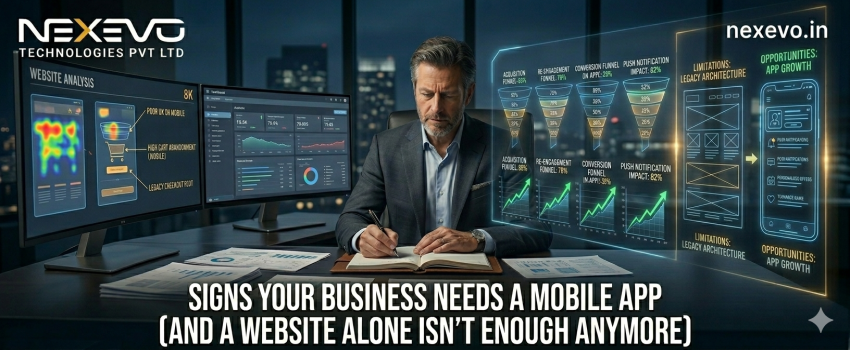
INTRODUCTION: Your Website Is Getting Traffic… So Why Does Growth Still Feel Slow?
Many businesses assume that once they build a website, their digital growth problems are solved.
And honestly, that assumption makes sense in the beginning.
Your website gives your business an online presence. It helps customers discover your products, explore your services, and contact your team. When traffic starts increasing through SEO, paid ads, or social media campaigns, it feels like things are moving in the right direction.
But then something frustrating happens.
Your traffic grows.
Your sales don’t grow at the same speed.
Customers visit your website once and disappear. Your marketing team keeps spending money to attract new users, but repeat purchases remain low. Mobile users abandon your website faster than desktop users. Competitors begin offering smoother customer experiences through mobile apps while your business struggles to retain attention.
This is usually the moment business owners begin asking uncomfortable questions.
"Why are people visiting but not returning?"
"Why are our competitors growing faster?"
"Why are mobile users dropping off so quickly?"
In many cases, the issue is not your marketing strategy.
The issue is that your business has reached a stage where a website alone can no longer support modern customer behavior.
Today’s customers expect faster experiences, personalized engagement, instant communication, and convenience that websites often struggle to deliver consistently.
That’s where mobile apps become a serious business growth tool—not just another digital trend.
Your Customers Keep Visiting Once—but They Rarely Come Back Again
This is one of the biggest hidden problems businesses ignore.
Many companies obsess over customer acquisition but completely ignore customer retention.
Imagine you run an ecommerce skincare brand.
A customer discovers your website through Instagram ads and purchases a product.
Everything looks great.
But 30 days later, when they need a refill, they don’t return.
They may forget your brand name. They may buy from Amazon. They may choose a competitor that remains visible through app notifications or personalized offers.
Your website helped you win the first sale.
But it failed to build a long-term relationship.
This creates a dangerous cycle where your business constantly spends money attracting new customers while losing previous ones.
A mobile app changes that equation.
Apps allow businesses to create retention systems through personalized recommendations, loyalty rewards, refill reminders, and faster repeat purchases.
One of our ecommerce clients faced this exact issue. Their website generated healthy traffic, but repeat orders remained low. After analyzing customer behavior, we recommended a lightweight mobile app that simplified repeat ordering and introduced personalized reminders. Over time, repeat customer engagement improved significantly.
Their real problem wasn’t traffic.
It was retention.
This is exactly where many businesses misunderstand app success.
They assume launching an app automatically guarantees retention and revenue growth.
In reality, many apps fail after launch because businesses ignore user onboarding, retention strategies, performance optimization, and long-term engagement planning.
If you want to understand why this happens, explore our blog on Why Mobile Apps Fail After Launch.
Your Mobile Website Experience Is Quietly Killing Conversions
Many business owners believe their website works perfectly because it looks good on desktop.
That’s a dangerous mistake.
Today, a huge percentage of users discover businesses through mobile devices.
Now imagine this customer journey.
A user clicks your Instagram advertisement.
They land on your website.
The website loads slowly.
The navigation feels clunky.
Forms are difficult to fill out.
Checkout takes too many steps.
The customer leaves.
This happens far more often than businesses realize.
Companies like Myntra, Nykaa, and Flipkart invest heavily in mobile apps because faster experiences directly improve conversions.
One retail client approached us after spending aggressively on paid marketing campaigns. Their traffic numbers looked impressive, but sales performance remained disappointing.
After reviewing their customer journey, we discovered that mobile checkout friction was causing significant abandonment.
A mobile app helped reduce those barriers by offering faster navigation, simplified checkout, saved payment preferences, and smoother user experiences.
However, many businesses make another costly mistake at this stage—they jump straight into development without choosing the right platform.
Some businesses need Android apps for broader market reach.
Some need iOS apps for premium audiences.
Others may benefit from cross-platform development to reduce costs and launch faster.
Choosing the wrong platform can create long-term performance and budget issues.
To understand what platform suits your business best, explore our blog on Android vs iOS vs Cross Platform App Development.
Their problem was never traffic.
Their platform was slowing customers down.
Your Business Needs Faster Communication With Customers
Websites are passive.
Customers must intentionally visit your website to interact with your business.
That model works for some businesses—but not all.
Let’s take healthcare as an example.
A patient books an appointment.
Without an app, they may forget appointment dates, miss updates, or struggle to access reminders.
Now imagine an app that sends appointment alerts, follow-up reminders, prescription notifications, and instant communication.
The customer experience becomes dramatically better.
The same applies to restaurants, logistics businesses, educational platforms, and subscription companies.
Zomato built customer habits by constantly staying connected through real-time notifications.
Customers know exactly when their food arrives.
That convenience creates loyalty.
If your business relies on ongoing customer communication, your website may not be enough anymore.
Your Competitors Are Becoming Easier to Buy From
Customers are loyal to convenience—not brands.
That may sound harsh, but it’s true.
If your competitor allows customers to reorder products in seconds while your website requires multiple steps, customers will choose the easier option.
Swiggy built enormous customer loyalty because ordering food became effortless.
Myntra simplified repeat shopping.
Uber removed booking friction.
All of these businesses understand one thing:
The easier you make customer actions, the faster your business grows.
If competitors are improving convenience faster than you are, that gap eventually becomes a revenue problem.
Your Business Depends on Repeat Transactions
Some businesses survive on repeat behavior.
Others don’t.
If you sell groceries, medicine refills, fashion products, subscriptions, food delivery, or recurring services, repeat transactions drive your revenue model.
A website alone may create awareness.
But it often struggles to create habit-forming behavior.
One healthcare client approached us because patients frequently forgot refill schedules.
They were losing repeat revenue opportunities simply because customers forgot.
We helped them create an app experience that made refill scheduling easier while improving customer convenience.
That small shift improved repeat transaction behavior.
Sometimes growth doesn’t require more traffic.
It requires making repeat purchases easier.
When You Should NOT Build a Mobile App
This is where many agencies lie.
Not every business needs an app.
And forcing one can waste serious money.
If your website barely gets traffic, your product-market fit is weak, or customers rarely need repeat engagement, building an app may be premature.
For example, a local law firm website may not need an app.
A one-time construction service may not need one either.
Sometimes businesses should first improve SEO, conversion optimization, customer acquisition, or operational systems before investing in app development.
A good technology partner should tell you when NOT to spend money.
How Nexevo Helps Businesses Build Apps That Actually Drive Growth
Many development companies focus only on launching apps.
That’s where businesses lose money.
Nexevo Technologies focuses on building apps that solve real business problems.
We help companies improve:
- customer retention
- mobile conversions
- repeat transactions
- scalability
- customer engagement
Whether you need Android apps, iOS apps, cross-platform development, or custom business applications, our team focuses on building solutions that support actual business growth.
Explore our Mobile App Development Services
Final Thoughts: Your Growth Problem Might Not Be Marketing
Many businesses spend months blaming SEO.
They blame paid ads.
They blame social media teams.
Sometimes those teams are doing their job perfectly.
The real issue is that your business has outgrown what a website alone can deliver.
If your customers keep leaving, repeat sales remain weak, and competitors are creating better experiences—it may be time to think bigger.
A mobile app isn’t always necessary.
But when it is, delaying that decision can cost your business serious growth opportunities.
Final CTA
If your website is generating traffic but failing to convert repeat customers into long-term revenue, it may be time to build something stronger.
Talk to Nexevo Technologies and explore mobile app solutions built for real business growth.

Jeyaprabhakaran Peter is the Senior Digital Marketing Specialist at Nexevo Technologies. With expertise in Digital Marketing, SEO, PPC, SMM, Content Strategy, Website Design, Figma Designing, and SEO Strategy, he helps brands grow their online presence effectively. As a skilled SEO Expert and Website Designer, he blends creativity with analytics to craft impactful digital strategies that deliver measurable results across various industries.
Share with





 Call
Call Whatsapp