What is Legacy Modernization? 5 Real Examples of Legacy Modernization


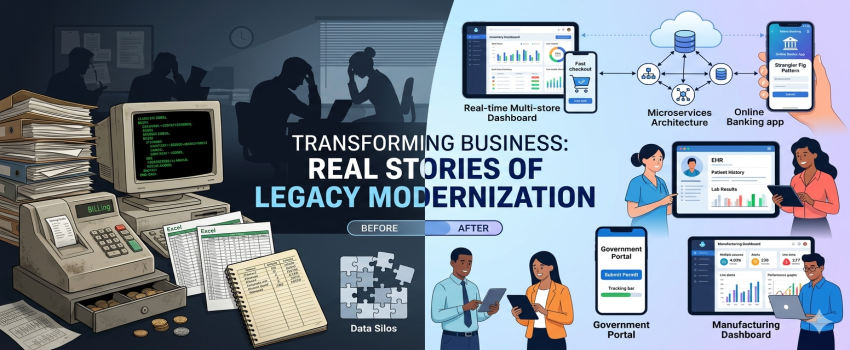
Most businesses don’t realize they have a legacy problem until it starts costing them customers, time, or revenue.
It doesn’t always look obvious. Sometimes it’s a billing system that slows down during peak hours. Sometimes it’s a report that takes weeks to generate. Sometimes it’s data scattered across tools that don’t talk to each other. These are all examples of legacy systems that once worked well, but now quietly hold the business back.
This is where modernization comes in.
But here’s the reality. Legacy modernization isn’t about replacing everything overnight. It’s about identifying what’s slowing you down and fixing it in a way that doesn’t disrupt your operations. That’s why many growing businesses choose to work with a legacy software development company in Bangalore to modernize systems step by step, without risking what already works.
In this blog, we’ll walk through real examples of legacy modernization across industries, from retail and banking to healthcare and manufacturing, and break down what changed, what worked, and what you can learn from them.
What is Legacy, Modernization & Legacy Modernization?
Before we get into the examples of Legacy Modernization, let's quickly know the basics.
Legacy – Meaning
Legacy refers to old or outdated systems, technologies, or processes that are still being used in a business.
Example:
A bank using a 20-year-old software system is called a legacy system.
Modernization – Meaning
Modernization means upgrading or improving something to meet current standards, technologies, or needs.
Example:
Moving from manual work to automation or upgrading software to cloud-based systems.
Legacy Modernization – Meaning
Legacy modernization is the process of updating or transforming old (legacy) systems into modern, efficient, and scalable solutions.
In simple words:
Legacy (old system) + Modernization (upgrade) = Legacy Modernization
Simple One-Line Definition
Legacy modernization means upgrading outdated systems to modern technologies for better performance, security, and scalability.
What is a legacy system?
A legacy system is any old software, tool, or technology that a business is still using — even though it's slowing them down or doesn't work well with newer tools. It could be a billing software from 2009, an Excel sheet used as a database, or a government portal built in 2004.
Legacy Modernization in Retail: The Grocery Chain That Almost Broke Every Festival Season
This is a classic example of legacy modernization in retail.
Meet Arjun
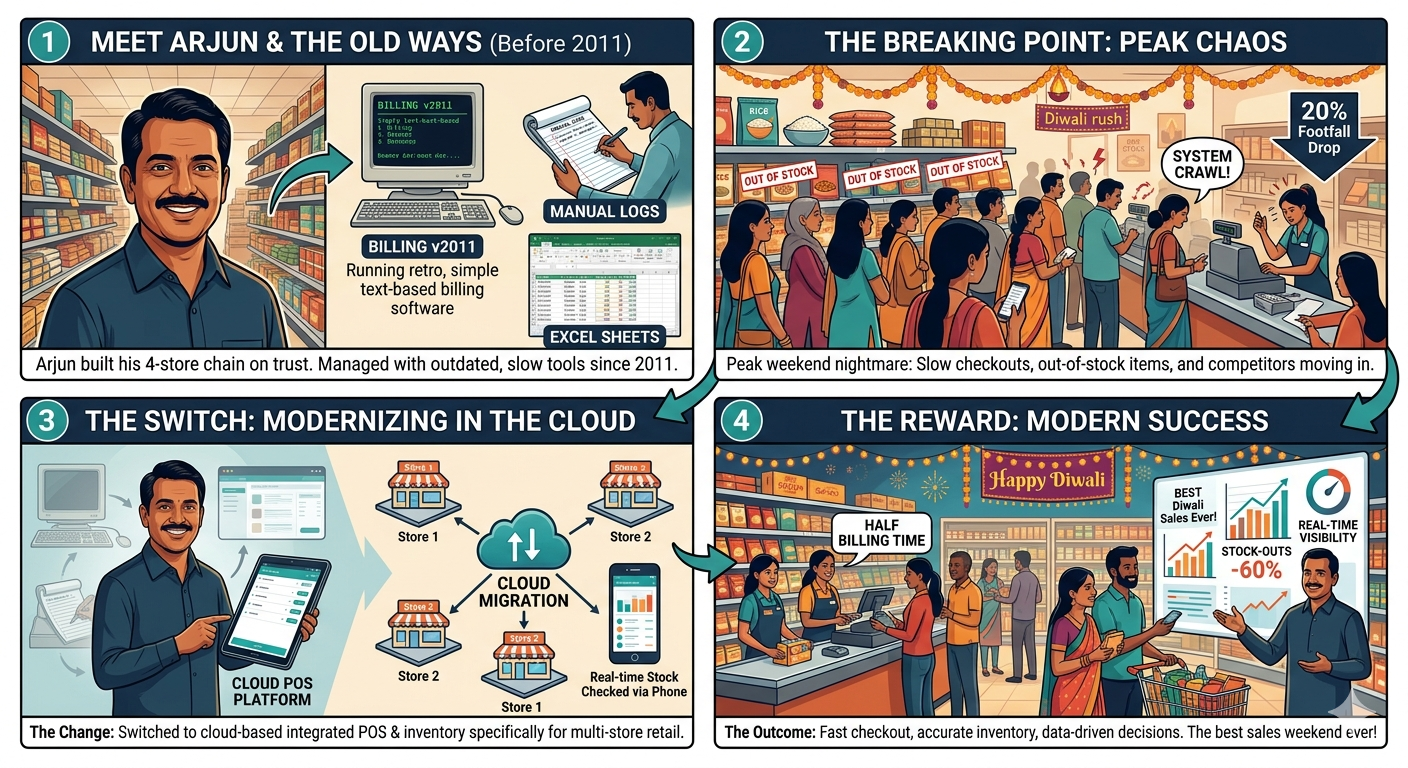
Arjun owns a chain of four grocery stores across a mid-sized city. He built the business over 14 years through early mornings, supplier relationships built on trust, and a loyal customer base that has shopped with him for decades.
For billing, he used desktop software his nephew installed back in 2011. For inventory, he had a combination of Excel sheets and a notebook his store managers updated manually every evening. It worked, mostly, until it didn't.
The problem
Every Diwali and every end-of-month weekend brought the same nightmare. Queues snaking out of the store. The billing system slowing to a crawl because four cashiers were using it simultaneously. Items running out of stock mid-day with no warning because the inventory sheet from last night was already 18 hours old.
"We lost at least three big shopping days every year because the system just couldn't keep up. Customers would walk in, not find what they wanted, and leave. Some never came back."
Then a competitor opened a store nearby with cleaner, faster checkout and an app that let customers check stock before coming in. Arjun's footfall dropped 20% in three months.
What he did for legacy system modernization in retail
Arjun didn’t hire a tech consultant or build a custom system. He moved to a cloud-based point-of-sale and inventory platform designed specifically for multi-location retail. Setup took two weekends. Training his staff took one week.
The old billing software was retired. The Excel sheets were gone. Every sale now updated inventory in real time across all four stores. He could check stock from his phone while sitting at home.
The outcome
→ Stock-outs during peak days dropped by over 60%
→ Checkout queues reduced; average billing time halved
→ Arjun could see which products were moving and which weren't daily, not monthly
→ The following Diwali was the chain's best sales weekend ever
The lesson for retail businesses
Legacy software examples in retail are everywhere: manual stock registers, decade-old billing tools, and disconnected systems. You don’t need a huge IT budget to modernize. You need the right cloud tool and the willingness to make the switch.
Legacy System Modernization in Banking: When Changing One Line of Code Takes Three Weeks
Another powerful example of legacy modernization comes from banking.
Meet Priya
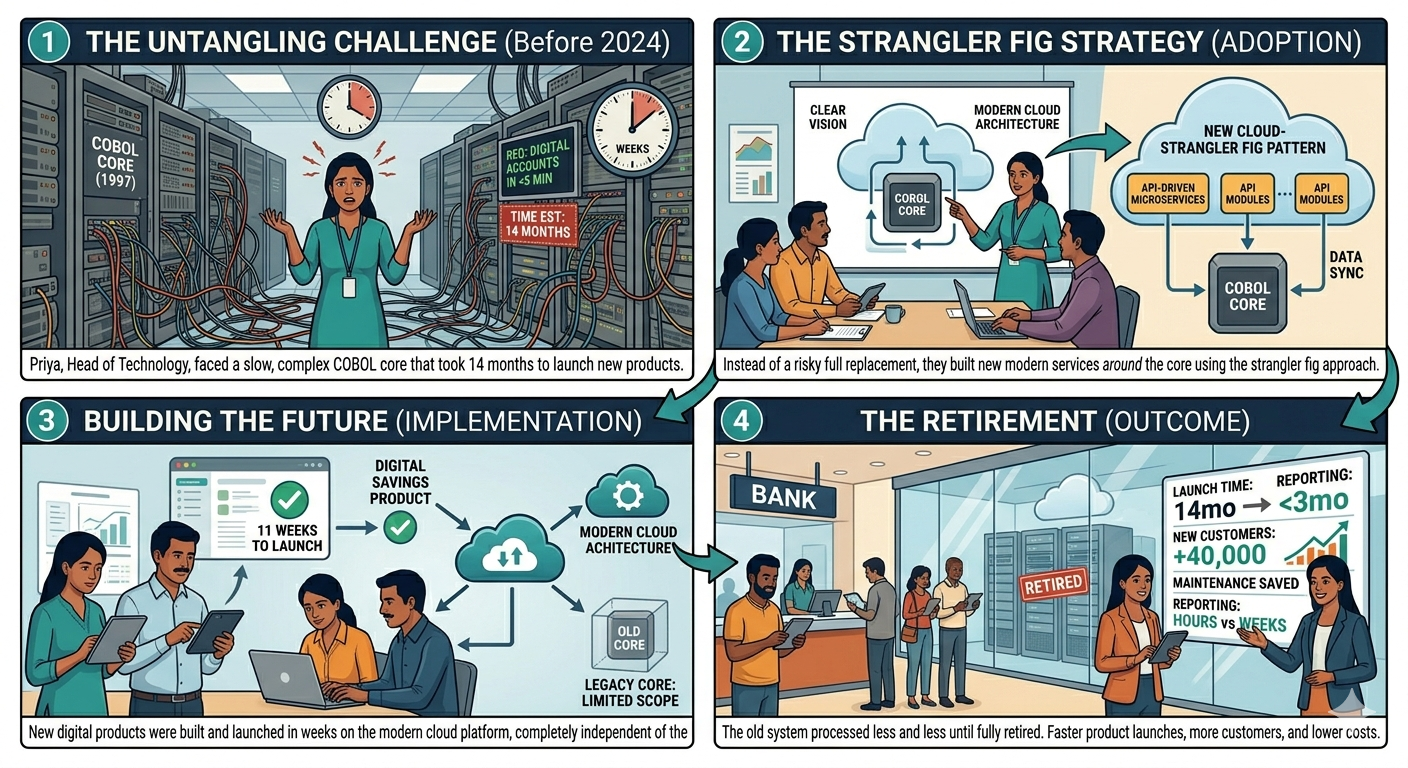
Priya is the Head of Technology at a regional bank with 200 branches. The bank has been operating for over 40 years. It has loyal customers, solid fundamentals, and a core banking system that was last significantly updated in 1997.
The system runs on COBOL, a programming language older than most of her team. When a new developer joins, they spend their first month trying to understand the codebase. When regulators ask for a new report, it takes six weeks to build. When fintech competitors launch a new feature, her bank takes six months.
The problem
Priya's bank wanted to launch a digital savings product for young customers, something simple, with account opening in under five minutes via mobile. Her team estimated it would take 14 months to build on the existing system.
By the time they launched, the market would have moved on. Three fintech apps already offered the same product, and two of them had launched in the past six months.
"We weren't slow because our people were slow. We were slow because every change required us to carefully untangle 40 years of interconnected code that nobody fully understood anymore."
What they did: modernizing without stopping the bank
Priya's team used what’s known as the strangler fig pattern, one of the most proven approaches in legacy system modernization. Rather than replacing the entire core at once, which is too risky when millions of transactions run daily, they built new services around it.
The digital savings product was built as a modern microservice, cloud-hosted, API-driven, and completely independent of the COBOL core except for essential data sync. It launched in 11 weeks.
Over the next two years, they gradually replaced the most painful parts of the legacy core, one module at a time: customer accounts, then payments, then reporting. The old system processed less and less until it was fully retired.
The outcome
→ New product launch time dropped from 14 months to under 3
→ The digital savings product acquired 40,000 new customers in year one
→ Maintenance costs on the old COBOL system were eliminated over three years
→ Regulatory reporting that took 6 weeks now runs in hours
The lesson for banking and finance
The strangler fig is the safest way to modernize a mission-critical system. You never bet the entire business on a big bang rewrite. You build around the old, route traffic to the new, and retire the legacy piece by piece. This is legacy modernization done right.
Legacy Modernization in Healthcare: The Hospital Where Doctors Made Decisions Without the Full Picture
This is one of the most critical examples of modernization in healthcare.
Meet Dr. Meera
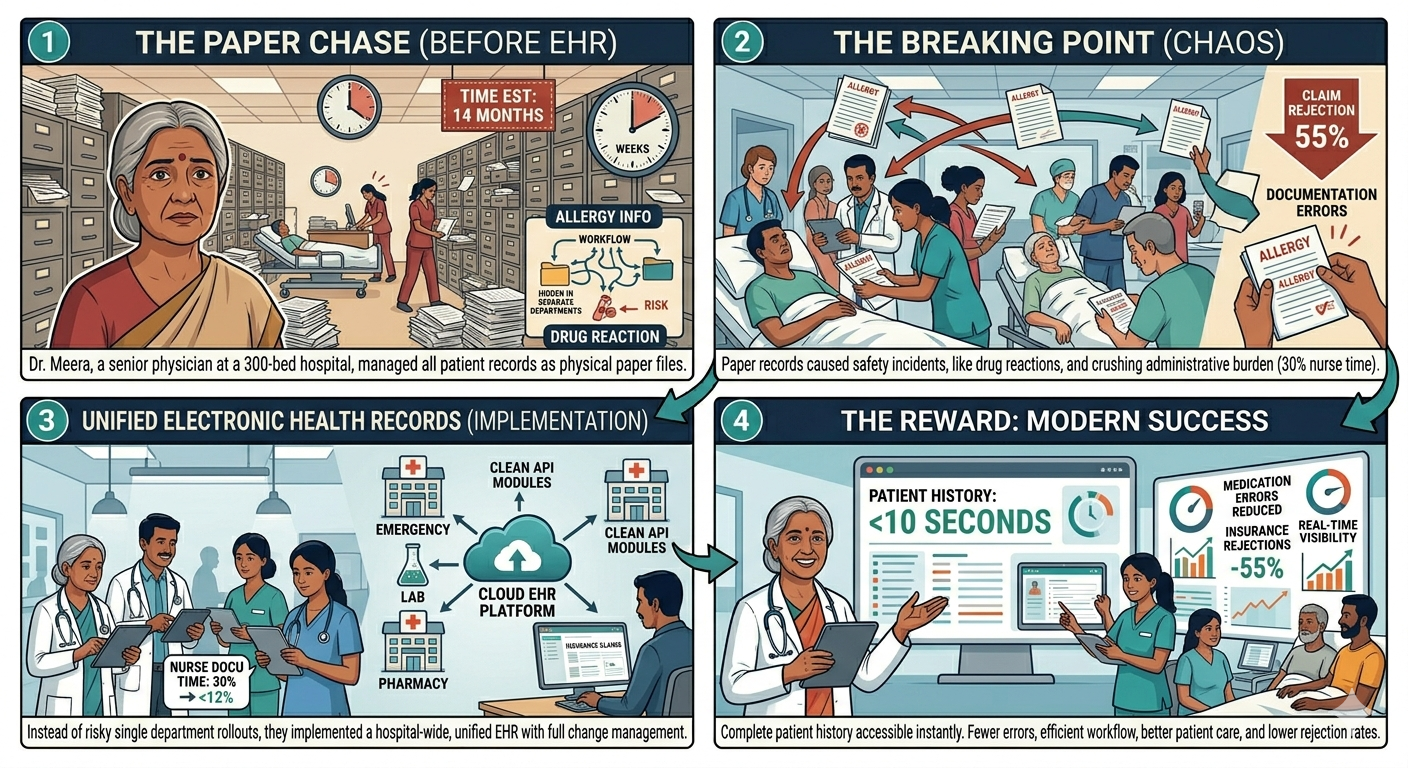
Dr. Meera is a senior physician at a 300-bed hospital that has served its community for 28 years. The hospital is well-respected. The staff are dedicated. And patient records – all of them – live in physical files stored in a room on the ground floor.
When a patient comes in for an emergency, a staff member has to physically locate the file. If the patient visited a different department last month, that record might be in a different folder. If it's a weekend, the records room is understaffed. Sometimes the file simply cannot be found in time.
The problem
Dr. Meera once treated a patient for a drug reaction. The patient had a known allergy; it was in their file. But the file was with another department during a concurrent consultation. Nobody knew. The patient was fine, but it was close.
Beyond safety, the administrative burden was crushing. Nurses spent 30% of their time on paperwork. Billing was delayed because records had to be manually cross-checked. Insurance claims were rejected constantly due to documentation errors.
"The technology we were using to manage patient care was the same technology used in the 1980s, paper and filing cabinets. Medicine had advanced enormously. Our systems hadn't moved at all." — A reality in hundreds of hospitals
What they did – modernizing healthcare records
The hospital implemented a unified Electronic Health Record (EHR) system. This wasn't just a technology change — it was a full workflow transformation. Every patient record was digitised. Every department connected to a single system. Allergies, medications, test results, consultation notes — all visible to any authorised clinician in seconds.
Change management was taken as seriously as the technology itself. Doctors and nurses were involved in choosing the system. Training happened in phases. A dedicated helpdesk ran for the first three months post-launch.
The outcome
→ Complete patient history accessible to any doctor in under 10 seconds
→ Medication error incidents reduced significantly in year one
→ Nurse documentation time dropped from 30% of shift to under 12%
→ Insurance claim rejection rate fell by 55% due to cleaner documentation
The lesson for healthcare
Legacy modernization in healthcare is not about technology for technology's sake. It's about what happens when a doctor has the information they need, when they need it. The EHR didn't just save time; in cases like Dr. Meera's, it can save lives.
Legacy Modernization in Government: The Permit That Took 11 Steps and Three Visits to the Office
Public sector systems are some of the clearest examples of legacy systems affecting daily life.
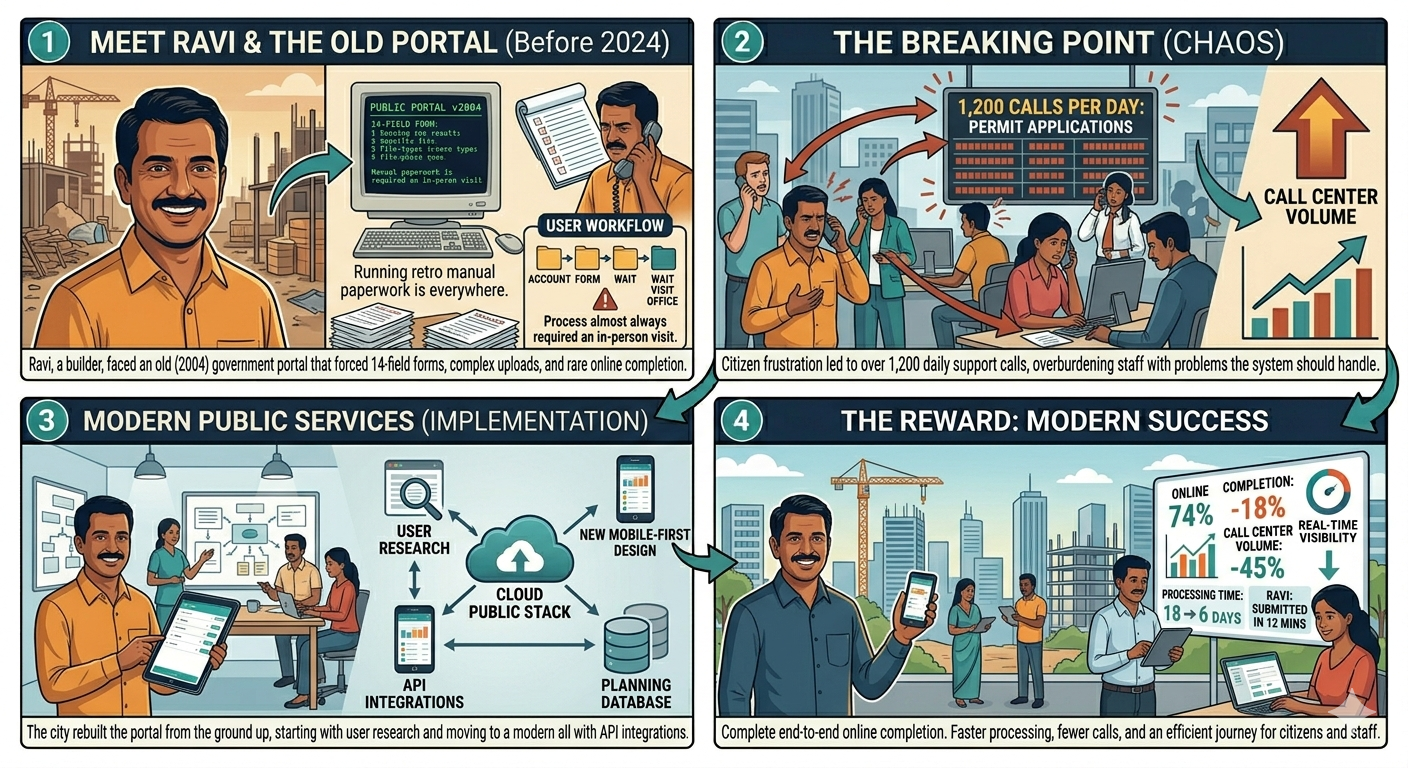
Meet Ravi
Ravi runs a small construction firm. He's not a tech person — he's a builder. But every time he needs a building permit, he spends more time dealing with the government portal than he does on actual project planning.
The portal was built in 2004. To apply for a permit, Ravi has to create an account, fill in a 14-field form, upload documents in specific file formats the portal demands, submit, wait for an email that may or may not arrive, and then — usually — visit the office in person because something in the digital submission didn't go through correctly.
He has applied for 47 permits in his career. He has never once completed the process entirely online.
The problem
The city's call centre received over 1,200 calls per day related to permit applications. Most were people like Ravi, confused, frustrated, stuck at some point in a broken digital process. The staff answering those calls were spending their days solving problems that the portal should have handled automatically.
"I've built hospitals and schools in this city. But I cannot figure out how to submit a permit application online. That tells you everything about the system." — Every small contractor who's ever dealt with a legacy government portal
What they did - modernizing public services
The city undertook a full rebuild of the permit portal — not just a cosmetic update, but a rethinking of the entire citizen journey. User research was conducted with actual applicants like Ravi. The new system was built mobile-first, with document upload that accepted any standard format, real-time status tracking, and automatic validation that flagged errors before submission rather than after.
The back-end was rebuilt on a modern cloud stack with API integrations to the city's planning database, eliminating the manual cross-checking that caused most of the delays.
The outcome
→ End-to-end online completion rate went from near 0% to 74%
→ Call centre volume dropped by 45% within six months
→ Average permit processing time reduced from 18 days to 6
→ Ravi submitted his last permit in 12 minutes, entirely from his phone
The lesson for public sector organisations
Government legacy software examples are some of the most impactful to fix — because the users have no alternative. They cannot switch providers. Modernizing public services isn't just about efficiency. It's about basic respect for people's time.
Example of Legacy Modernization in Manufacturing: Running a Factory Blind
This is a practical example of legacy modernization without replacing everything.
Meet Suresh
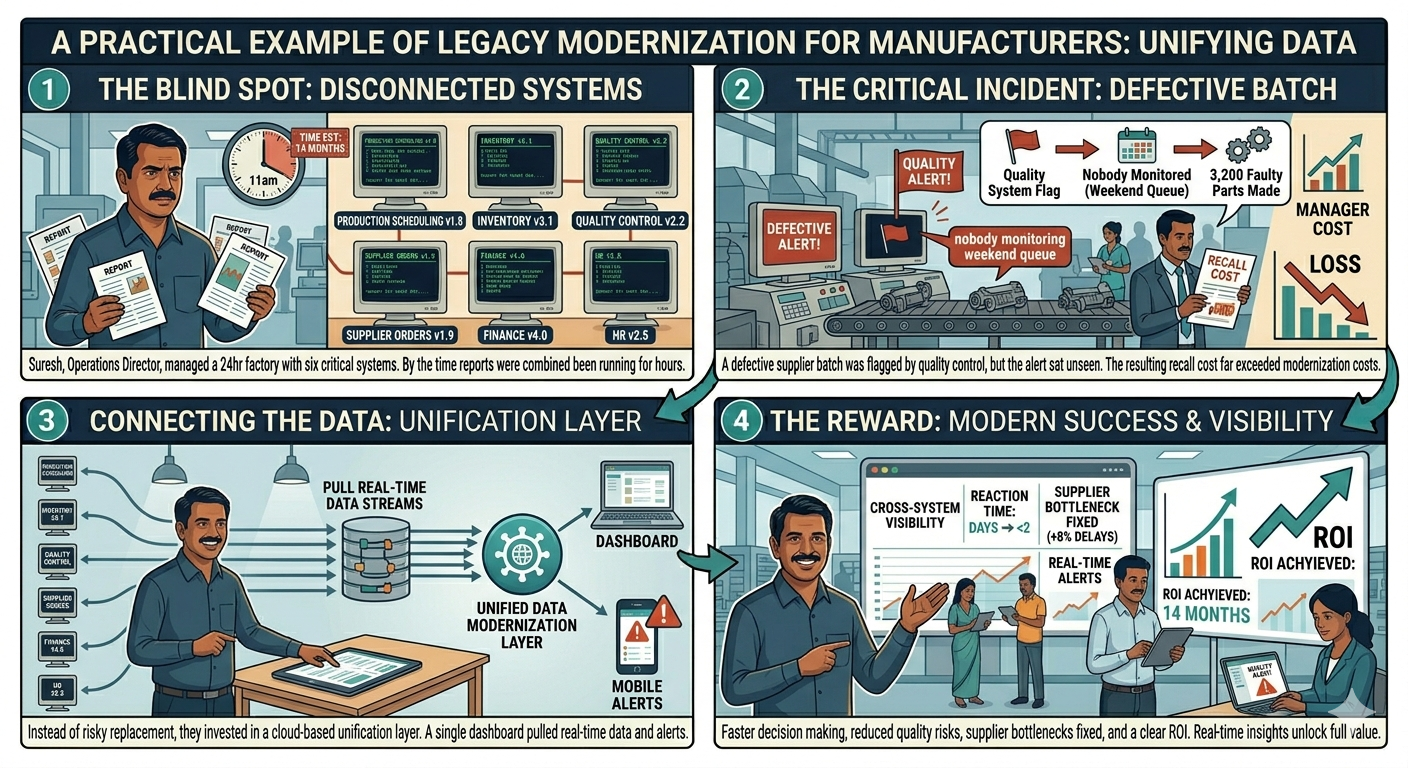
Suresh is the operations director at a mid-sized auto parts manufacturer. The factory runs 24 hours a day across three shifts. They supply components to four major OEMs. Delivery precision is everything — a missed shipment can shut down an assembly line.
The factory runs on six different software systems. One for production scheduling. One for inventory. One for quality control. One for supplier orders. Two more for finance and HR. None of them talk to each other.
Every morning, Suresh gets six different reports from six different systems. By the time his team has reconciled them into something usable, it's 11am. By then, whatever problem they identify has been running for hours.
The problem
A batch of defective components from a supplier made it into production. The quality system flagged it — but the flag sat in a queue nobody monitored over the weekend. By Monday, 3,200 faulty parts had been manufactured and some had already shipped.
The recall cost the company far more than a modernization project would have. But more painfully — the data to prevent it existed. It just wasn't visible to the right people at the right time.
"We had data everywhere and insight nowhere. Every system knew something. But nobody had the full picture until it was too late." — The operational blind spot in manufacturing
What they did - connecting the data
Suresh's team didn't replace all six systems. That would have taken years and cost a fortune. Instead they invested in a data modernization layer, a unified cloud-based data platform that pulled real-time feeds from all six systems into a single dashboard.
Alerts were set up for critical thresholds: quality flags, inventory drops below safety stock, supplier delivery delays. The data that used to sit in a queue now landed on the right screen, immediately.
This is one of the most practical examples of modernization for manufacturers: you don't always need to replace what you have. Sometimes you just need to connect it.
The outcome
→ Cross-system visibility reduced decision-making time from days to hours
→ Quality alert response time dropped from 48 hours to under 2
→ One identified supplier bottleneck was fixed, saving 8% in production delays annually
→ ROI on the data platform achieved in 14 months
The lesson for manufacturing
Sometimes modernization isn't about replacing systems, it's about making them talk to each other. A data unification layer can unlock the full value of systems you've already invested in, without the risk of replacing them all at once.
What All 5 Examples of Legacy Modernization Have in Common
Arjun's grocery chain. Priya's bank. Dr. Meera's hospital. Ravi's city government. Suresh's factory. Five completely different industries. Five completely different legacy software examples. But the same pattern underneath every single one.
- Nobody modernised all at once. Every successful example was phased and incremental.
- The pain was always specific, a lost sale, a missed deadline, a safety incident, a frustrated customer. The pain is what made modernisation urgent.
- The technology decision followed the business problem, not the other way around.
- People were the hardest part. Training, change management, and buy-in mattered as much as the software.
- The outcomes were measurable. Not "we feel more efficient", actual numbers, actual improvement.
The pattern is consistent across every industry: find the pain → pick the right strategy → modernize in phases → measure what changes. That's legacy system modernization in practice.
So, Which Story Is Yours?
Maybe you saw yourself in Arjun, manually managing inventory that should update itself. Maybe it was Priya, watching competitors move fast while you're stuck in a decade-old system. Maybe it was Suresh, swimming in data but blind to insight.
Legacy modernization doesn't start with a technology decision. It starts with an honest look at what's costing you, time, customers, money, safety, or competitive edge.
The businesses in these stories didn't wait for a perfect plan. They started with the most painful problem. Then the next one. That's how transformation actually happens.
Start here: What is the single most painful thing your current system makes harder than it should be? That's where your modernization begins.
Frequently Asked Questions
Which of the following is an example of legacy modernization
A grocery shop moving from a 2011 billing software to a cloud POS system is a simple example of legacy modernization. A bank replacing a 40-year-old COBOL system with modern microservices is a larger one. Both count — the scale is different, the concept is the same.
What is a legacy system in simple terms?
A legacy system is old software or technology that still works but is now slowing your business down. It could be an Excel sheet used to track inventory, an old billing tool, or a server-based software that can't connect with newer apps.
Which industries need legacy modernization the most?
Banking, healthcare, retail, manufacturing, and government are the most common. But any business running on software older than 7–10 years likely has some legacy problem worth fixing.
Do you have to replace everything at once?
No — and most experts say you shouldn't. The safest approach is to modernize one piece at a time, starting with whatever is hurting you the most right now.
How long does legacy modernization take?
It depends on the size of the system. A small retail business can modernize in a few weeks. A bank modernizing its core system can take 2–3 years. Most mid-size businesses see meaningful results within 3–6 months of starting.

Mr. Habeeb the CEO of Nexevo Technologies. As a diplomatic leader with 15+ years of experience specialize in helping many organizations through strategic planning, problem-solving, creative thinking, and achieving goals. Expertized in Branding and Marketing with proven records in delivering outstanding results for many clients in various industries.
Share with




 Call
Call Whatsapp