OpenAI and Microsoft End Their Exclusivity Deal



Navigate to
- Chapter 1: How This Partnership Began
- The Partnership Timeline
- Chapter 2: What the Exclusivity Deal Actually Meant
- Chapter 3: Why the Deal Ended
- Chapter 4: The AI Race Is Now Fully Open
- Chapter 5: What This Means for Businesses
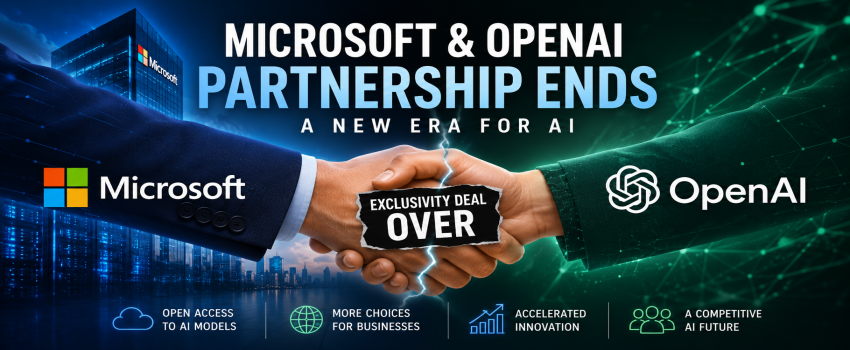
Imagine two of the most powerful companies in the world shaking hands on a deal that gives one of them exclusive control over the future of artificial intelligence. That's exactly what happened between Microsoft and OpenAI. And now, that deal is over.
This isn't just a business headline. It's a turning point. For years, Microsoft was the only company allowed to fully distribute and commercialize OpenAI's most advanced AI technology. Every time a business wanted to use ChatGPT's power in their products, they had to go through Microsoft's platform.
That era has ended. And what comes next could reshape how AI is built, sold, and used across the entire world.
In this blog, we'll break it all down in simple, clear language — no technical jargon, no confusing charts. Just the story of what happened, why it matters, and what it means for the future of AI.
Whether you're a business owner, a student, a tech enthusiast, or just someone who uses AI tools like ChatGPT in your daily life — this change affects you. Let's explore why.
Chapter 1: How This Partnership Began
To understand why this moment matters, we need to go back to the beginning. OpenAI was founded as a nonprofit research organization with one mission: make sure artificial intelligence benefits all of humanity. It was a bold vision — but a bold vision needs funding.
That's where Microsoft came in. In 2019, Microsoft invested heavily in OpenAI, becoming its primary cloud partner and financial backer. The deal made sense for both sides. OpenAI got the computing power and money it needed to build world-class AI. Microsoft got early, exclusive access to the most powerful AI technology in the world.
The Partnership Timeline
| 2019 | Microsoft made its first major investment in OpenAI. Azure became the exclusive cloud home for all of OpenAI's AI workloads and research. |
| 2020 | GPT-3 launched and stunned the world with its ability to write essays, answer questions, and generate code — better than anything seen before. |
| 2021 | GitHub Copilot launched, powered by OpenAI's Codex model. This was the first product that brought AI-powered coding to millions of developers worldwide. |
| 2022 | ChatGPT launched in November and became the fastest-growing consumer app in history, reaching 100 million users in just two months. |
| Jan 2023 | Microsoft announced a new multi-year, multi-billion dollar investment in OpenAI, deepening the exclusive partnership significantly. |
| 2023 | Microsoft launched Copilot across its Office products — Word, Excel, PowerPoint, Teams — powered exclusively by OpenAI's technology. |
| 2024 | Competition from Google Gemini, Meta's Llama, and other AI tools began to intensify, putting pressure on both OpenAI and Microsoft. |
| 2025 | OpenAI and Microsoft renegotiate. Exclusivity restrictions end. OpenAI is now free to work with any partner globally. |
This timeline tells the story of a partnership that went from a startup's lifeline to a full commercial empire. And like many great partnerships, it eventually needed to evolve.
The key shift was simple: OpenAI grew up. It transformed from a research lab into one of the world's most valuable private companies. With that growth came the natural desire for more independence — and Microsoft, which had already built a powerful AI business of its own, was ready to let OpenAI fly.
Chapter 2: What the Exclusivity Deal Actually Meant
Let's make this very clear. When we say 'exclusivity deal,' here's what that actually meant in practice:
What Microsoft Could Do (That Others Couldn't)
- Use OpenAI's GPT models in all Microsoft consumer and enterprise products
- Offer OpenAI's models to businesses through the Azure OpenAI Service
- Access new OpenAI models before anyone else in the market
- Set the pricing and terms for how businesses accessed OpenAI's technology
- Build products that no competitor could replicate with the same AI power
What This Meant for Everyone Else
For companies that used Amazon Web Services (AWS), Google Cloud, or any other cloud platform — accessing OpenAI's best models was limited, indirect, or simply not available. This created a real competitive imbalance.
Businesses had to choose: switch to Microsoft's platform to get the best AI, or build with less capable alternatives. This was a significant barrier that shaped the entire enterprise AI market for years.
Why This Was Such a Big Deal
Cloud platforms are the backbone of modern business technology. When the best AI tools are locked to one cloud platform, it forces companies to reorganize their entire tech infrastructure just to access them. Ending exclusivity removes that barrier completely.
Chapter 3: Why the Deal Ended
So if this deal gave Microsoft such a huge advantage, why end it? The answer involves growth, strategy, and mutual benefit.
OpenAI's Perspective
OpenAI's ambitions have grown far beyond what a single-partner deal can support. The company now wants to:
- Partner directly with Google Cloud, AWS, and other major platforms
- Sign enterprise deals with governments and international corporations
- Expand its consumer products like ChatGPT globally without restrictions
- Prepare for a potential public offering that requires broader business independence
- Build an AI ecosystem that reaches every corner of the technology world
Microsoft's Perspective
Microsoft didn't lose anything by agreeing to this change. In fact, it gained something valuable: a stronger, more independent OpenAI partner.
- Microsoft Copilot is already deeply embedded in Office, Teams, and Windows
- Azure OpenAI Service has thousands of enterprise customers already locked in
- Microsoft keeps preferred pricing and early access to new OpenAI models
- A more successful OpenAI means more demand for Azure cloud services
- Releasing exclusivity signals confidence — and builds goodwill with regulators
Chapter 4: The AI Race Is Now Fully Open
With exclusivity gone, we've entered a new phase of AI competition. Every major technology company is now on a level playing field when it comes to partnering with OpenAI or building their own AI alternatives. Here's a look at the key players:
| Microsoft | Still the closest partner and largest investor in OpenAI. Products like Copilot, Bing AI, and Azure OpenAI Service give Microsoft a strong head start in enterprise AI adoption. |
| OpenAI | Now operating with full commercial freedom. ChatGPT is the world's most recognized AI product. GPT-4o and new voice/image capabilities are pushing the boundaries of what AI can do. |
| Google / DeepMind | Google's Gemini model competes directly with GPT-4 across writing, coding, and reasoning tasks. With Google Search, Android, and Chrome, Google has unmatched distribution power. |
| Meta (Facebook) | Meta's Llama models are open-source, meaning any developer can use and modify them for free. This strategy builds a massive developer community and challenges closed AI systems like GPT. |
| Amazon / AWS | Amazon has invested heavily in AI research and offers multiple AI models through its Bedrock platform. AWS's scale makes it a major force in enterprise AI infrastructure. |
| Apple | Apple is quietly building on-device AI capabilities focused on privacy. With over a billion iPhone users, Apple's AI push could reach more everyday consumers than any other company. |
Startups & New Players | Hundreds of AI startups are building specialized tools for healthcare, education, legal, and creative industries, many now able to access OpenAI's technology on any platform they choose. |
Chapter 5: What This Means for Businesses
For business owners and company decision-makers, the end of this exclusivity deal is genuinely exciting news. Here's why:
More Choices, Less Lock-In
Previously, accessing the best AI tools often meant committing to Microsoft's Azure cloud platform. That's no longer the case. Businesses can now choose the cloud provider that works best for their needs, their budget, and their existing technology — and still access OpenAI's powerful models.
Lower Costs Over Time
Competition naturally drives prices down. With more companies competing to offer AI services, vendors will have to offer better pricing, better service, and better support to win business. That's a direct win for every company using AI tools.
More Innovation, Faster
When companies compete, they innovate. Expect to see AI products improve faster, new features launch more frequently, and genuinely useful tools emerge that solve real business problems, not just impress in demos.
AI Is Now a Universal Utility
Think about electricity. In the early days, businesses had to build their own power systems. Eventually, electricity became a utility — something every business could access from any provider. AI is following the same path. The end of this exclusivity deal is a major step toward AI becoming a universal business utility.
For Business Owners
If your business has been waiting to adopt AI because of platform concerns or cost, now is a great time to explore your options. The market is opening up, and the tools available in 2025 are more capable and affordable than ever before.

Nexevo Technologies is a Professional web designing and web development company bangalore, which is offers a full facility for designing a website at a reasonable price. We are award-winning web design and digital marketing company working since 2012.
Share with




 Call
Call Whatsapp